Choosing the right automotive plastic parts manufacturer is one of the most critical decisions an OEM engineering or procurement team will make. The wrong partner means delayed programs, failed inspections, and costly retooling. The right partner means predictable output, dimensional consistency, and a supplier that understands what production-critical actually means.
This guide covers the key factors engineering and procurement teams use to evaluate automotive plastic parts manufacturers — from tooling discipline to quality systems — and explains what separates production-ready suppliers from those that will slow your program down.
Why Tooling Engineering Matters in Automotive Plastic Manufacturing
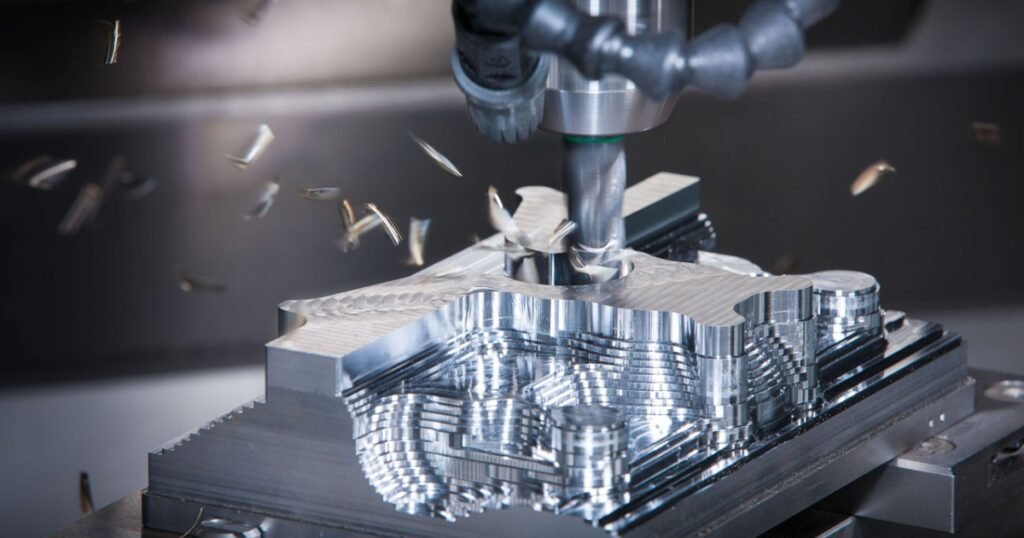
Most automotive plastic component failures are rooted in tooling — not production. Poorly designed molds lead to warpage, sink marks, flash, and dimensional drift over time. By the time these problems show up in production, the cost to fix them is exponentially higher than catching them in DFM.
An experienced automotive plastic parts manufacturer builds tooling with the end in mind. That means:
- Running mold flow analysis before cutting steel
- Designing for consistent cooling to minimize cycle variation
- Building in dimensional controls from day one
- Owning the tooling process rather than outsourcing it
When tooling is engineered to production requirements — not just prototype requirements — the path from first article to stable mass production is significantly shorter and less risky.
5 Key Factors to Evaluate an Automotive Plastic Parts Manufacturer
Selecting the right manufacturing partner requires looking beyond price and lead time. For Tier 1 and Tier 2 automotive programs, these are the five factors that matter most.
1. DFM Capability & Engineering Support
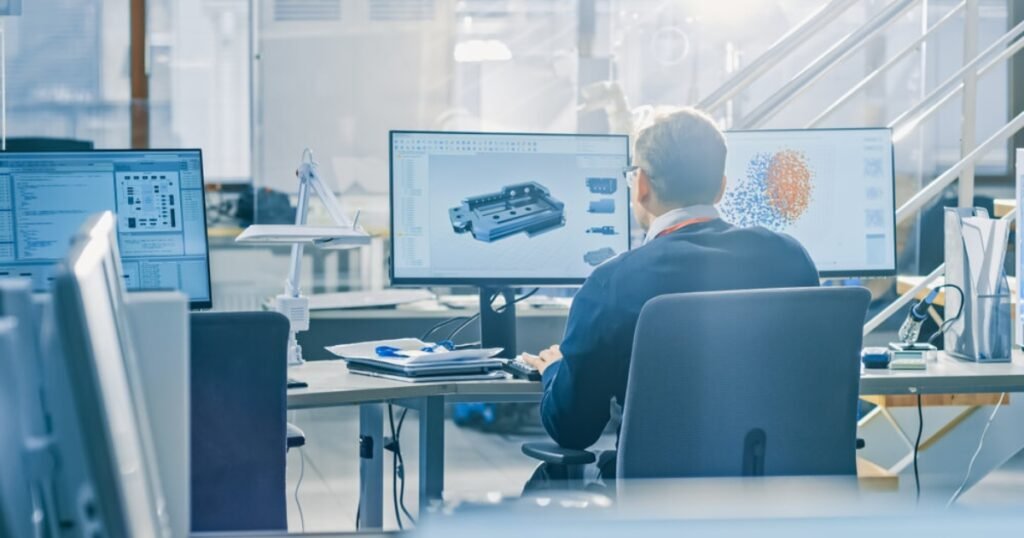
Design for Manufacturability (DFM) is the foundation of any successful automotive plastic component program. A manufacturer with strong DFM capability will identify issues before they become production problems — wall thickness inconsistencies, gate location risks, draft angle deficiencies, and tolerance stack-up concerns.
What to look for:
- Do they provide written DFM reports with specific recommendations?
- Do they run mold flow simulation before tooling?
- Is their engineering team involved early, before quoting?
A manufacturer that simply takes your file and quotes it without engineering review is a risk. A partner who challenges your design to protect your program is an asset.
2. Tight Tolerance & Quality Validation Process
Automotive plastic components demand dimensional consistency across thousands of cycles. The question is not whether a manufacturer can hit tolerance on part one — it is whether they can maintain it across an entire production run.
Look for:
- CMM (Coordinate Measuring Machine) inspection capability
- 3D scanning for complex geometry validation
- First Article Inspection (FAI) reports with documented traceability
- Statistical Process Control (SPC) in production
These are not nice-to-haves for automotive programs. They are table stakes.
3. Tooling Ownership & Mold Control
Who owns and controls the tooling directly affects your program’s long-term stability. Manufacturers that outsource mold fabrication introduce a dependency that can slow your response time when tooling adjustments are needed — and they will be needed.
The best automotive plastic parts manufacturers:
- Design and fabricate tooling in-house or in tightly controlled facilities
- Maintain mold history and preventive maintenance schedules
- Can make tooling adjustments quickly without third-party delays
- Build multi-cavity and family molds with consistent cavity-to-cavity performance
Tooling control is program control. Suppliers who cannot tell you exactly who made your mold or where it is stored are a liability.
4. Production Scalability — Samples to Mass Production
A supplier that is excellent at prototyping but cannot scale to high-volume production will stall your program at the worst possible time. Evaluate production capacity before you need it.
Questions to ask:
- What is their press tonnage range, and how many machines are available?
- Can they support both sampling and full production simultaneously?
- Do they have documented scale-up processes?
- What does their capacity look like at peak program demand?
The best automotive plastic parts manufacturers have planned for scale. They can support initial samples, pre-production validation builds, and then ramp to full production volumes without requiring you to qualify a new supplier mid-program.
5. Communication & Project Management Quality
Technical capability is only half the equation. For U.S.-based OEM engineering and procurement teams, responsive and clear communication is essential — especially when managing global manufacturing.
What good communication looks like:
- A dedicated project manager as the single point of contact
- Engineering-to-engineering communication availability
- Clear and timely responses to NCRs, deviation requests, and change notices
- Proactive issue escalation rather than reactive problem reporting
Poor communication extends lead times, increases risk, and makes program management harder than it needs to be. This is often the hidden cost of working with low-cost suppliers who lack U.S.-based support.
IATF 16949 Certification — Why It Matters for Automotive OEMs
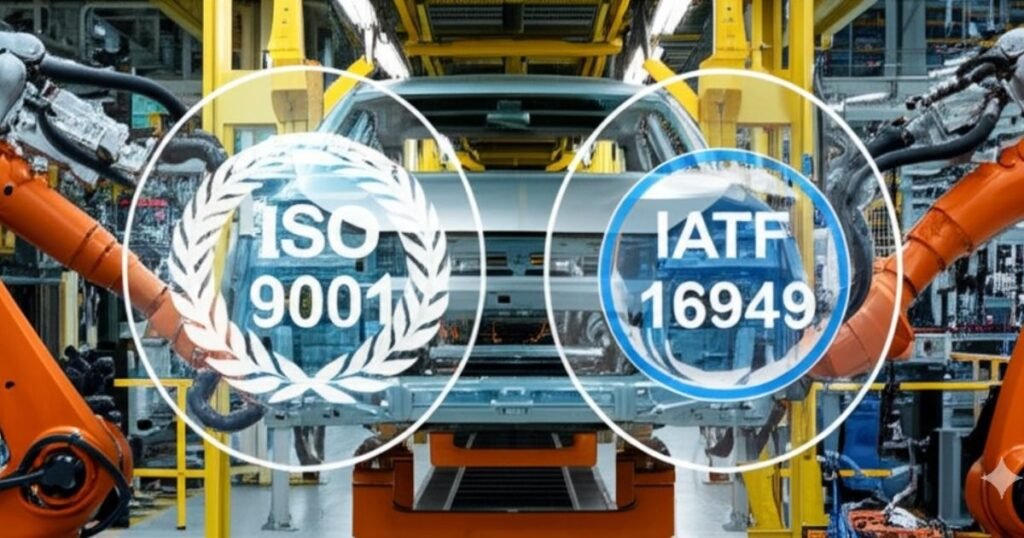
IATF 16949 is the internationally recognized quality management standard for automotive production and relevant service parts. For Tier 1 and Tier 2 suppliers, working with an IATF 16949 certified manufacturer is often a non-negotiable requirement.
Certification to this ISO quality standard means:
- The manufacturer has documented and audited processes covering design, production, and delivery
- Risk management and quality planning are built into the production system
- Continuous improvement and corrective action processes are formalized
- Customer-specific requirements are systematically tracked and met
For automotive programs with strict quality records requirements — full traceability, PPAP documentation, and ongoing SPC data — IATF 16949 certification is the baseline that reduces qualification risk on both sides.
When evaluating suppliers, ask for their current certification scope and verify it covers the specific processes your program requires — injection molding, tooling, assembly, or all three.
How Haumann Supports Automotive Plastic Component Programs
Haumann is an engineering-driven automotive plastic parts manufacturer supporting Tier 1 and Tier 2 OEM programs from DFM through mass production. Our platform combines German-engineered tooling discipline with Houston-based project management and scalable global production capacity.

What makes Haumann different for automotive programs:
- German-engineered tooling — mold design and fabrication built to automotive dimensional standards, with full process control from steel cut to first article
- Advanced DFM & mold flow analysis — engineering review before tooling begins, with documented recommendations and mold flow simulation
- Houston-based communication — a U.S.-based engineering and project management team that responds at your speed, in your time zone
- IATF 16949 certified quality systems — CMM inspection, 3D scanning, FAI reporting, and full traceability built into every program
- Scalable production — from pre-production samples to multi-cavity high-volume runs, with consistent quality standards across both U.S. and China facilities
- Integrated manufacturing — injection molding, CNC machining, and assembly under one program, reducing supplier handoffs and protecting program timelines
We manufacture automotive plastic components for interior, exterior, and under-hood applications — including structural housings, functional modules, precision inserts, and integrated sub-assemblies. All components are manufactured to ASTM material specifications and automotive quality requirements.
If your program requires a supplier that understands what production-critical means — not just what it sounds like — Haumann is built for that conversation.
Ready to Evaluate Your Automotive Plastic Parts Program?
Whether you are qualifying a new supplier, managing a production risk, or planning a new program launch, the right first step is a manufacturing review.
Haumann’s engineering team will review your part design for manufacturability, assess tooling risk, and provide a clear plan for moving from DFM to stable production.
Our Houston-based team responds within one business day.