
A metal endcap for an LED lighting fixture is now an injection molded part. The customer used a metal endcap on this fixture and converted it to plastic. We built the mold — a cassette mold with interchangeable inserts in one mold base — and we produce the part in flame-retardant PC ABS, rated UL 5VA. From customer confirmation to T0 took 20 days, and the first trial produced qualified samples. The conversion also brought the cost per part down significantly.
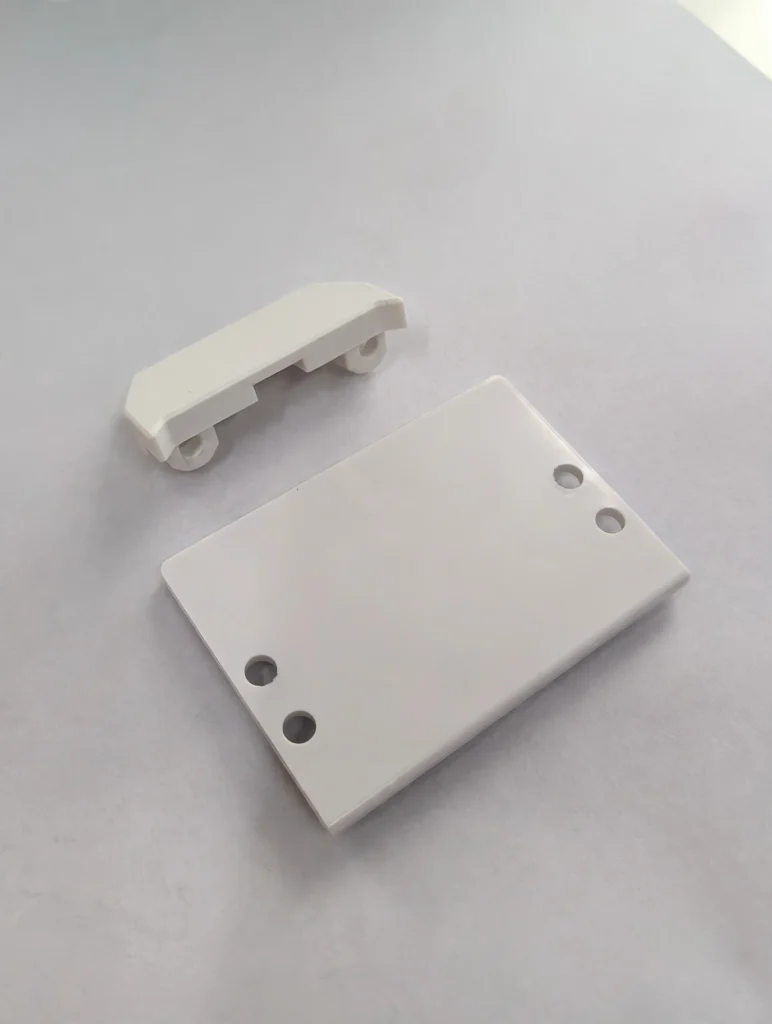
That is the whole story in one paragraph. The rest of this page is the evidence behind it: what the part is, what it is held to, and how the conversion was proven at the first trial.
At a glance
| Challenge | Solution | Result |
|---|---|---|
| Convert a metal endcap for an LED lighting fixture to an injection molded part, and hold the drawing tolerance on a molded part. | A cassette mold built by Haumann, with interchangeable inserts in one mold base, in flame-retardant PC ABS rated UL 5VA, engineered and trialled to the drawing. | Qualified samples at the first trial — 20 days from customer confirmation to T0. Molding and demolding ran smoothly, with a very good appearance and surface finish. Cost per part down significantly vs the metal part. The part is now produced by Haumann in black and white. |
The part at a glance
| Item | Detail |
|---|---|
| Part | Injection molded endcap for an LED lighting fixture |
| Previous version | Metal endcap, converted to injection molded plastic |
| Material | PC ABS, flame retardant grade, UL 5VA rated |
| Colours supplied | Black and white |
| Drawing units | Inches |
| General tolerance | ±0.015 in (about ±0.38 mm) |
| Three-decimal dimensions | ±0.005 in (about ±0.13 mm) |
| Holes | ±0.002 in (about ±0.05 mm) |
| Mold | Cassette mold, interchangeable inserts in one mold base, built by Haumann |
| Production | By Haumann |
| Confirmation to T0 | 20 days |
| First trial | Qualified samples; molding and demolding ran smoothly, very good appearance and surface finish |
| Cost per part | Down significantly vs the metal part (no figure supplied) |
The challenge
A metal part and a molded part are not the same part with a different material. Converting one to the other means rethinking how the part is made: how it fills, how it cools, where it shrinks, and how it holds its dimensions once it comes out of the mold.
For this endcap, the drawing set the bar. The general tolerance is ±0.015 in, about ±0.38 mm. Three-decimal dimensions are held to ±0.005 in, and holes to ±0.002 in. Those are the numbers the molded part had to meet — not on a good day, but as a repeatable result.
The material choice was part of the challenge too. A lighting fixture endcap has to be flame retardant, and this one is made in PC ABS, flame retardant grade, rated UL 5VA. The material had to suit the part, the process and the rating — all at once.
The solution
We built the mold for this part, and we produce the part.
The tooling is a cassette mold: interchangeable inserts in one mold base. For a simple part like this endcap, that keeps the tooling cost down, lets inserts be changed quickly, and makes maintenance easy — a worn or damaged insert can be replaced on its own, without replacing the whole mold.
The part and the mold are simple by design, and that showed at the trial. Molding and demolding ran smoothly at the first trial, and the parts came out with a very good appearance and surface finish.
The work followed the same route we use on every conversion: understand the drawing and the tolerance it demands, design the tool for the material and the process, and prove it at trial. From customer confirmation to T0 took 20 days.
That timeline matters because it is measured, not estimated. Confirmation to T0 in 20 days, with qualified samples at the first trial, means the tooling, the material and the process were right before the trial started — not fixed after it.
The result
The first trial produced qualified samples. The part is now in production with Haumann, supplied in black and white.
There is no second-trial story here, because there was no second trial needed to qualify the part. The conversion did what it was supposed to do: the metal endcap became a molded endcap, to the drawing, on the first trial.
It also changed the economics of the part. The cost per part came down significantly against the metal version, and mass production is simpler and easier now: every cycle produces the same finished part, with no extra finishing steps after molding.
Why metal-to-plastic conversion is worth considering
Converting a metal part to injection molding is not the right move for every part. It is worth considering when the part suits molding — when the geometry, the material and the volumes fit the process.
In general, a conversion can bring:
- Lower part cost, once production volumes justify the tooling.
- Lower weight than the metal part it replaces.
- Fewer pieces and less assembly — ribs, bosses and fixing points can be molded into one part.
- Colour and surface texture finished in the mold, with no painting, plating or coating step afterwards.
- No corrosion in service.
- Consistent dimensions from part to part, because every part comes from the same tool.
Whether it is right for a specific part depends on the drawing, the material and the application. That is a conversation for engineering, not a claim on a page.
If you have a metal part you are thinking of converting, the useful first step is the drawing. Send it to us and we will tell you honestly whether molding fits — and what it would take to prove it.
Frequently asked questions
The questions and answers below are also published as the Haumann FAQ accordion (Appendix A) with matching FAQPage schema (Appendix B).
Have a metal part to convert?
If you have a metal part that might suit injection molding, talk to our engineering team. Send the drawing and we will tell you whether molding fits, what material would suit it, and what it would take to prove it at trial.
Related
- High-volume injection molding services — from 100,000 to 10M+ parts a year, multi-cavity tooling and SPC quality control.
- Contact Haumann — request a quote or talk to engineering.