How Sporting Goods Are Manufactured: From Design to High-Volume Production
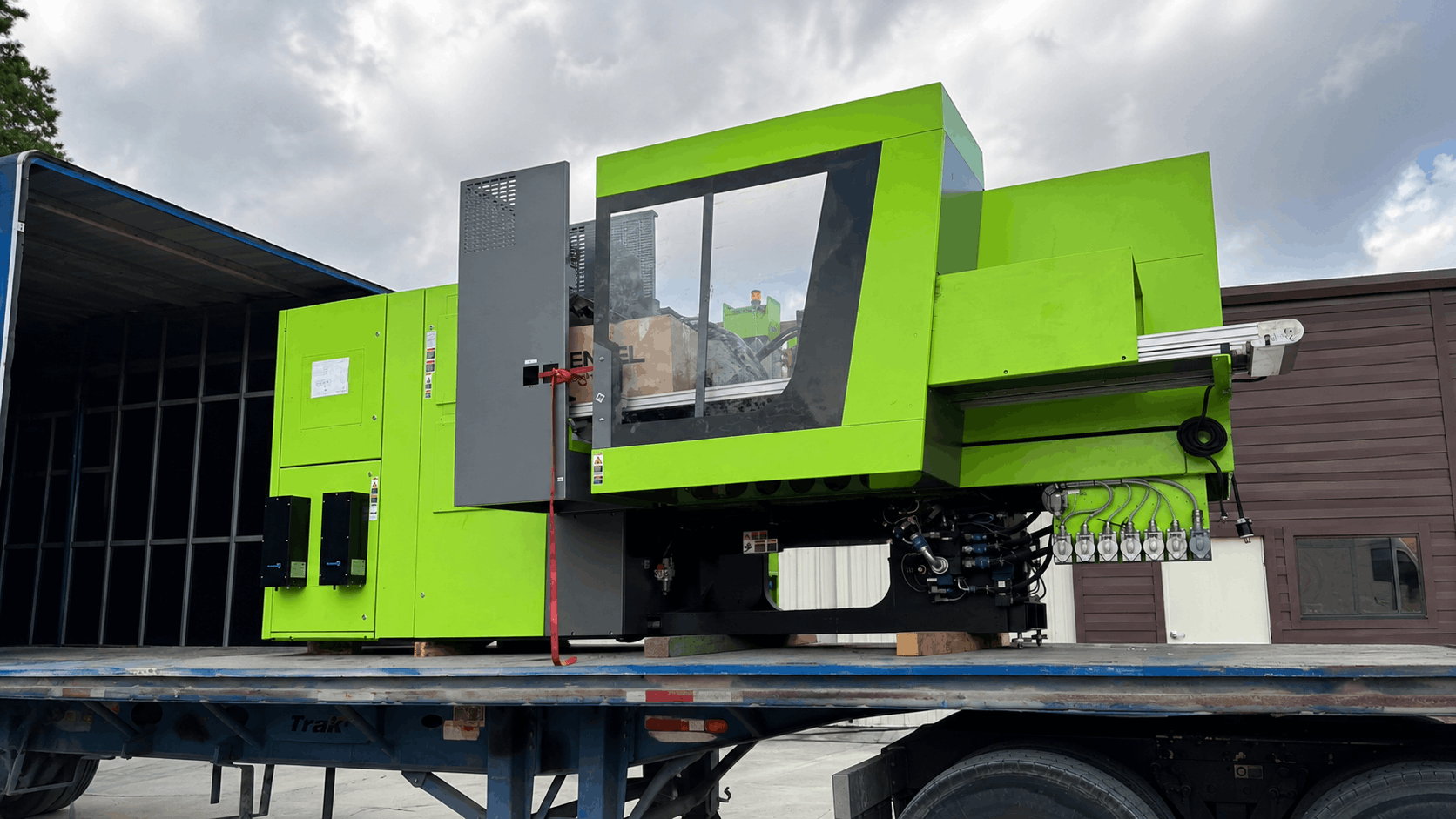
Most sporting goods that are not sewn are injection moulded. The binding frame on a snowboard, the chassis of a wakeboard boot, the buckle on a helmet strap, the sole structure of a performance shoe — each begins as plastic pellets, is melted and injected into a steel mould under pressure, and comes out as a finished component in seconds. What separates a product that survives seasons of impact from one that cracks in its first month is decided long before that moment: in the design review, the tooling, the material choice and the quality system around the moulding machine.
The short answer: sporting goods are manufactured in six stages — (1) product design and DFM review, (2) mould tooling, (3) material selection and preparation, (4) injection moulding, (5) secondary operations and assembly, and (6) quality testing and pack-out. This guide walks through each stage the way an OEM manufacturer actually runs it, using the same process we apply on our own sports & outdoor products programmes.
Key Takeaways
- Injection moulding is the dominant process for rigid and semi-rigid sports components because it repeats complex geometry exactly, at cycle times measured in seconds.
- Tooling is the biggest decision: aluminium/bridge tools validate a design in weeks; hardened steel Class 101 tools carry high-volume production for years.
- Materials are engineering grades — glass-filled nylon for frames and bindings, TPU/TPE for soles and grips, polycarbonate for protective shells, carbon fibre composites for elite performance parts.
- Quality is a system, not an inspection at the end: DFM and mould-flow analysis before steel is cut, first-article inspection before production, SPC and CMM checks during it.
- The fastest programmes work with one partner for moulding, secondary operations and assembly, under NDA, with engineering accountability in the customer’s own time zone.
The Six Stages at a Glance
| Stage | What happens | What it decides |
|---|---|---|
| 1. Design & DFM | CAD review, mould-flow simulation, wall/gate/draft optimisation | Whether the part can be moulded without defects at all |
| 2. Tooling | Aluminium bridge tool or hardened steel production mould is designed and machined | Unit cost, tolerances, tool life and timeline |
| 3. Materials | Resin selected and prepared (drying, moisture control, lot verification) | Strength, flex, weight and weather resistance of the product |
| 4. Moulding | Injection moulding, often multi-cavity and with overmoulding or inserts | Repeatability of every dimension, cycle after cycle |
| 5. Secondary ops & assembly | Heat staking, ultrasonic welding, insert fitting, CNC finishing, sub-assembly | How components become a finished, working product |
| 6. Quality & pack-out | CMM/3D-scan inspection, impact and fatigue testing, traceability, packing | Whether what ships matches what was approved |
Stage 1: Product Design and DFM Review
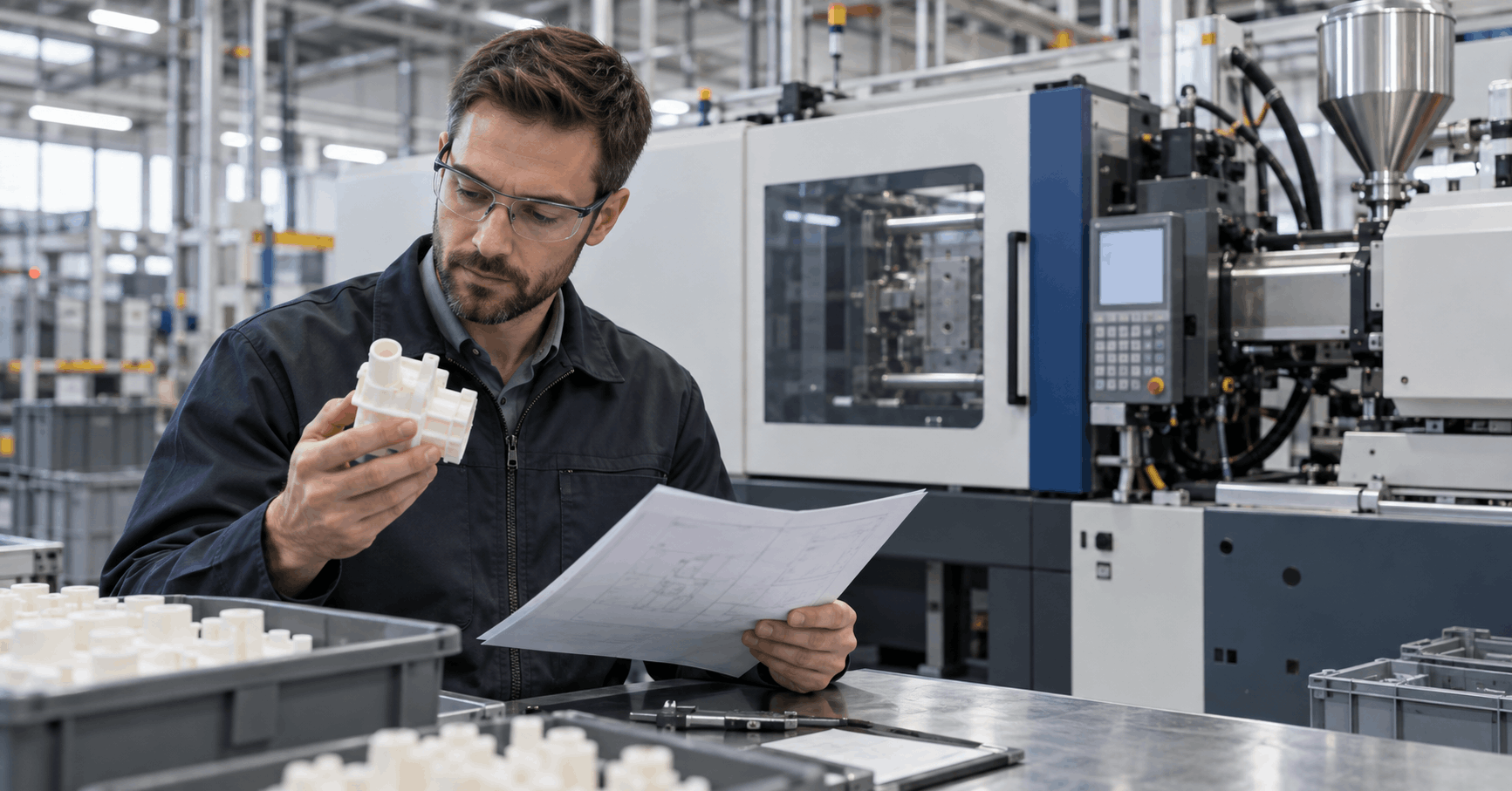
Every programme starts with a 3D model and a question: can this geometry actually be moulded, thousands or millions of times, without warping, sinking, or cracking at the weld lines? Design for Manufacturability (DFM) is where that question is answered — before any steel is cut, while changing the design still costs nothing.
A proper DFM review checks wall thickness transitions (thick-to-thin jumps cause sink marks and internal stress), draft angles (so parts eject cleanly), gate position (which decides where weld lines form — and weld lines are where sports parts break under impact), and fibre orientation in glass-filled materials, because aligned fibres make the part strong in one direction and weaker in another. Mould-flow simulation predicts filling, shrinkage and warpage digitally, so the first physical trial confirms the simulation instead of discovering problems.
At Haumann, this review is run by our Houston engineering team on every RFQ, and your files are protected before they are even opened: a formal B2B NDA is executed before CAD models reach the review desk. For start-up brands, this stage is also where the tooling strategy is set — the decision our sporting goods manufacturing team makes with every new programme.
Stage 2: Tooling — the Mould Decides Everything
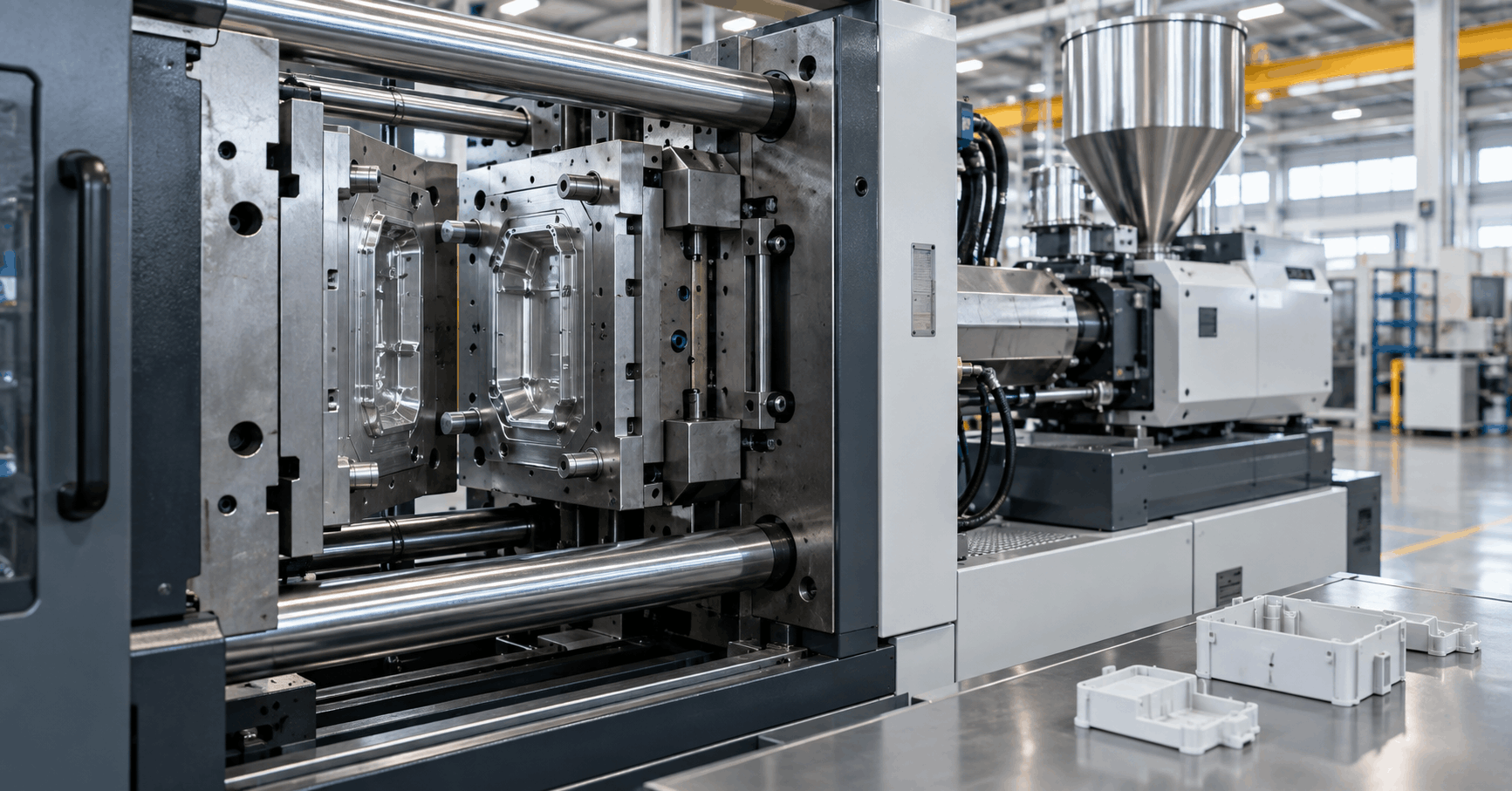
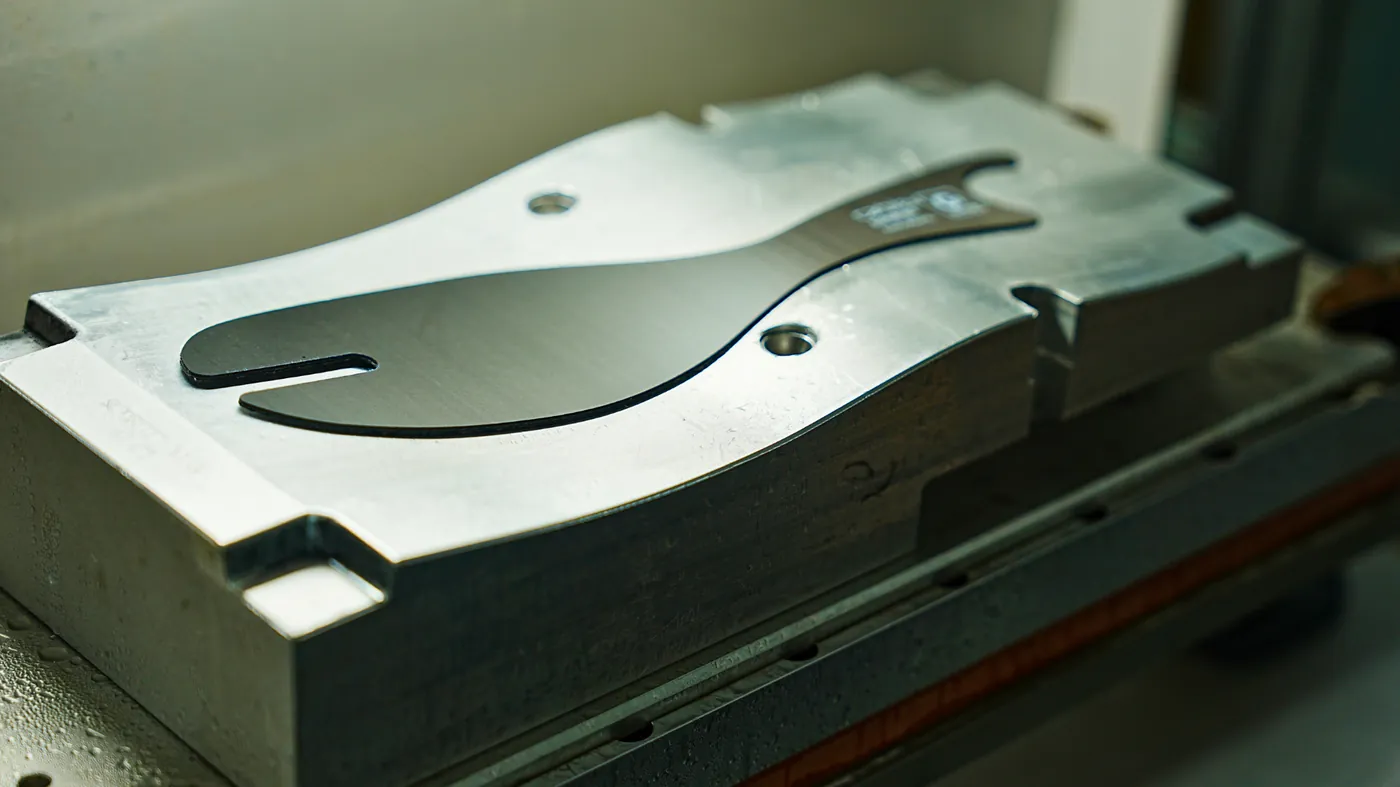
The injection mould is a precision steel tool — two halves, a cavity shaped like the part, cooling channels, ejector pins — and it is the single largest investment in the programme. It is also where quality is really manufactured: a part can never be better than the tool that forms it, which is why injection mould tooling deserves more scrutiny than the machine it runs on.
There are two tooling routes, chosen by expected volume:
- Aluminium and bridge tooling — faster and cheaper to machine (on our programmes, typically 2 to 3 weeks), ideal for prototypes, design validation and first market batches. Through our Startup OEM Program, brands validate with short runs of roughly 500 to 1,000+ parts before committing to production steel.
- Hardened steel production tooling (Class 101) — built for long life at high volume, with multi-cavity layouts, hot-runner systems and wear-resistant steels such as H13 or P20. A complex multi-cavity steel mould typically takes 4 to 6 weeks including first-article inspection — and then produces consistent parts for years.
First-article inspection (FAI) closes this stage: the first parts off the tool are measured against the CAD model, tested, and formally approved. Production does not start until the tool — not just the part — is proven.
Stage 3: Materials — Where Performance Is Chosen
Sporting goods live a harder life than most plastic products: UV, cold, sweat, salt water, and repeated impact at exactly the points where the athlete’s force concentrates. Material selection is therefore a performance decision, not a purchasing one. These are the material families that dominate the category:
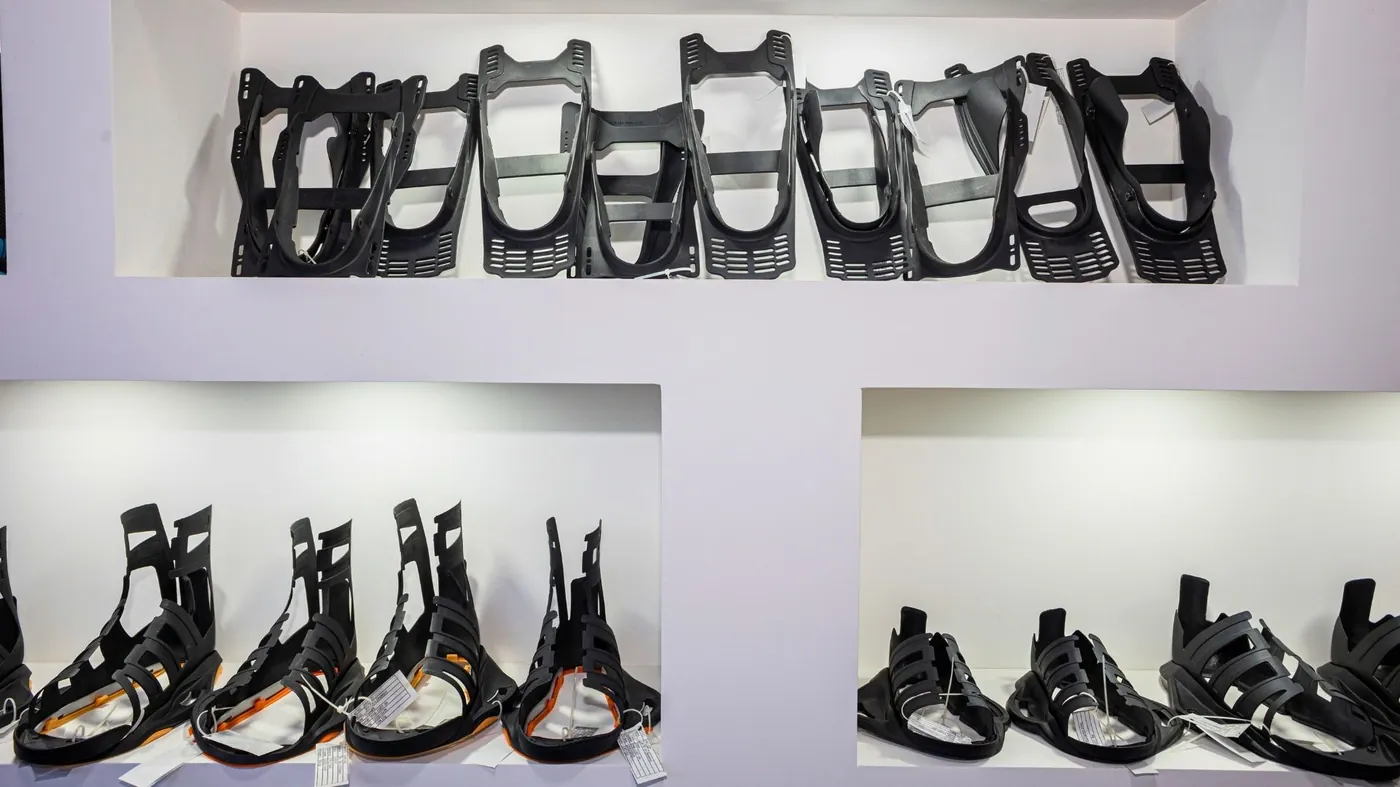
Structural frames and bindings: glass-filled nylon (PA6 / PA66-GF)
Binding chassis, boot frames, mounting interfaces and load-bearing hardware are moulded from nylon reinforced with glass fibre. The fibres carry the load; the resin holds the shape through cold, heat and moisture cycling. Getting the fibre orientation right — predicted at DFM stage — is what keeps a binding frame from snapping at its weld line on a cold morning.
Flexible and comfort parts: TPU and TPE
Soles, grips, straps, cushioning elements and soft-touch surfaces use thermoplastic elastomers. TPU brings abrasion resistance and elastic recovery for outsoles and performance footwear; TPE brings soft, grippy surfaces. Both are frequently overmoulded — moulded directly over a rigid frame (Stage 5) so the soft and hard parts become one component.
Protective shells and housings: polycarbonate and ABS
Helmet shells, protective housings and equipment enclosures use impact-modified polycarbonate and ABS for their toughness and surface finish. Small precision hardware — buckles, ladders, adjusters — often uses POM for its low friction and crisp snap fits.
Elite performance parts: carbon fibre composites
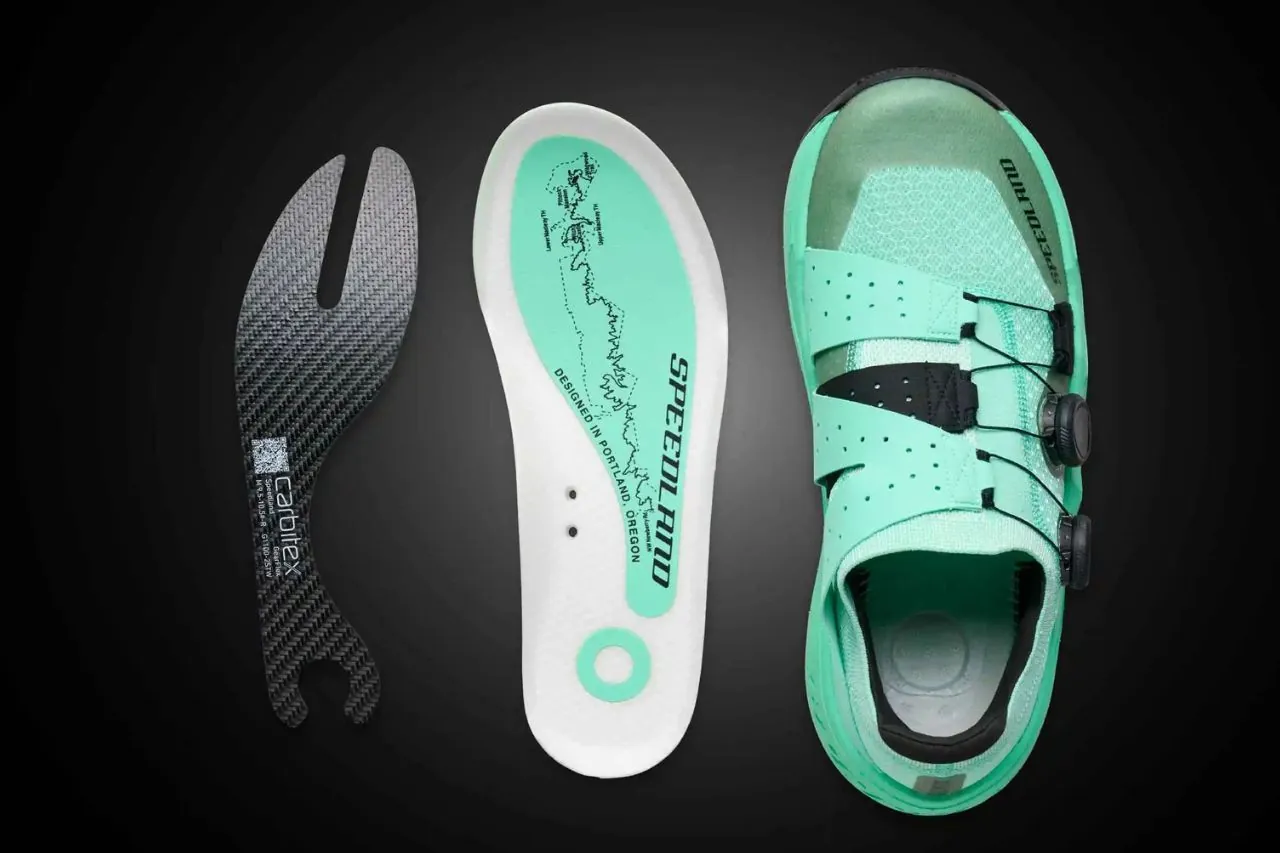
Where stiffness-to-weight decides performance, moulded plastic gives way to carbon composite: layup of carbon fabric layers, hot-press curing, then CNC trimming to final geometry — the process behind the footwear plates and structural components on our carbon composites manufacturing line. Carbon’s stiffness can be tuned by layer direction, which is why it dominates elite running shoes and high-end bindings.
Whatever the material, preparation matters as much as selection. Hygroscopic resins like nylon are dried and moisture-checked before moulding; every resin lot is verified and logged, because batch traceability (Stage 6) starts here. Our footwear injection moulding programmes run the same discipline across TPU soles, nylon frames and carbon inserts in a single product.
Stage 4: Injection Moulding at Scale
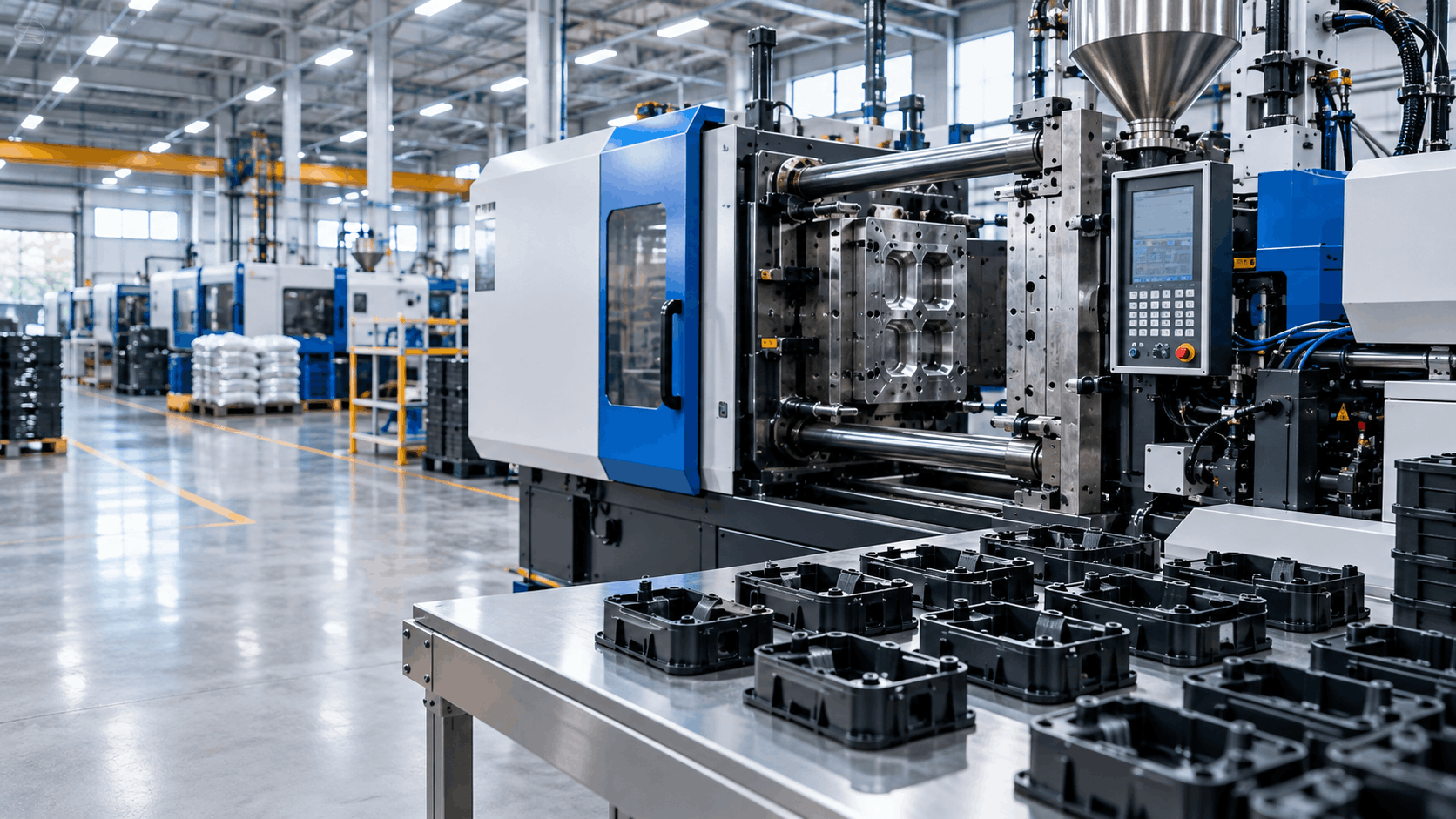
With the tool approved and the material prepared, production moulding is a study in repeatability. Pellets are plasticised in a heated barrel, injected into the closed mould under controlled pressure and speed, held while the part cools in the cavity, and ejected — a cycle repeated identically, often in multi-cavity tools that produce several parts per shot.
Three production techniques matter most in sports products:
- Multi-cavity moulding — several identical cavities in one tool multiply output per cycle; this is how bindings, buckles and footwear components reach high volumes economically.
- Insert moulding — metal inserts, threaded hardware or carbon composite pieces are placed in the cavity and moulded in, emerging as one integrated component with no secondary fastening.
- Overmoulding — a second shot moulds TPU/TPE directly over the rigid substrate: soft grips over hard frames, flexible soles bonded to structural chassis, seals integrated into housings. Done well, the bond is chemical and mechanical at once; done badly, it delaminates under flex — which is why the process window (substrate temperature, mould temperature, injection profile) is validated, not guessed.
Throughout the run, the process is monitored statistically — barrel and cavity pressures, cycle times, part weights — so drift is caught before it becomes scrap. On our Houston floor, presses from 50 to over 500 tons handle everything from micro buckles to large structural frames under the same monitoring discipline.
Stage 5: Secondary Operations and Assembly
A moulded part is rarely a finished product. A binding needs straps, buckles and padding fitted; a boot needs its liner, hardware and sole assembled; an equipment housing needs its electronics and seals. Secondary operations turn components into products:
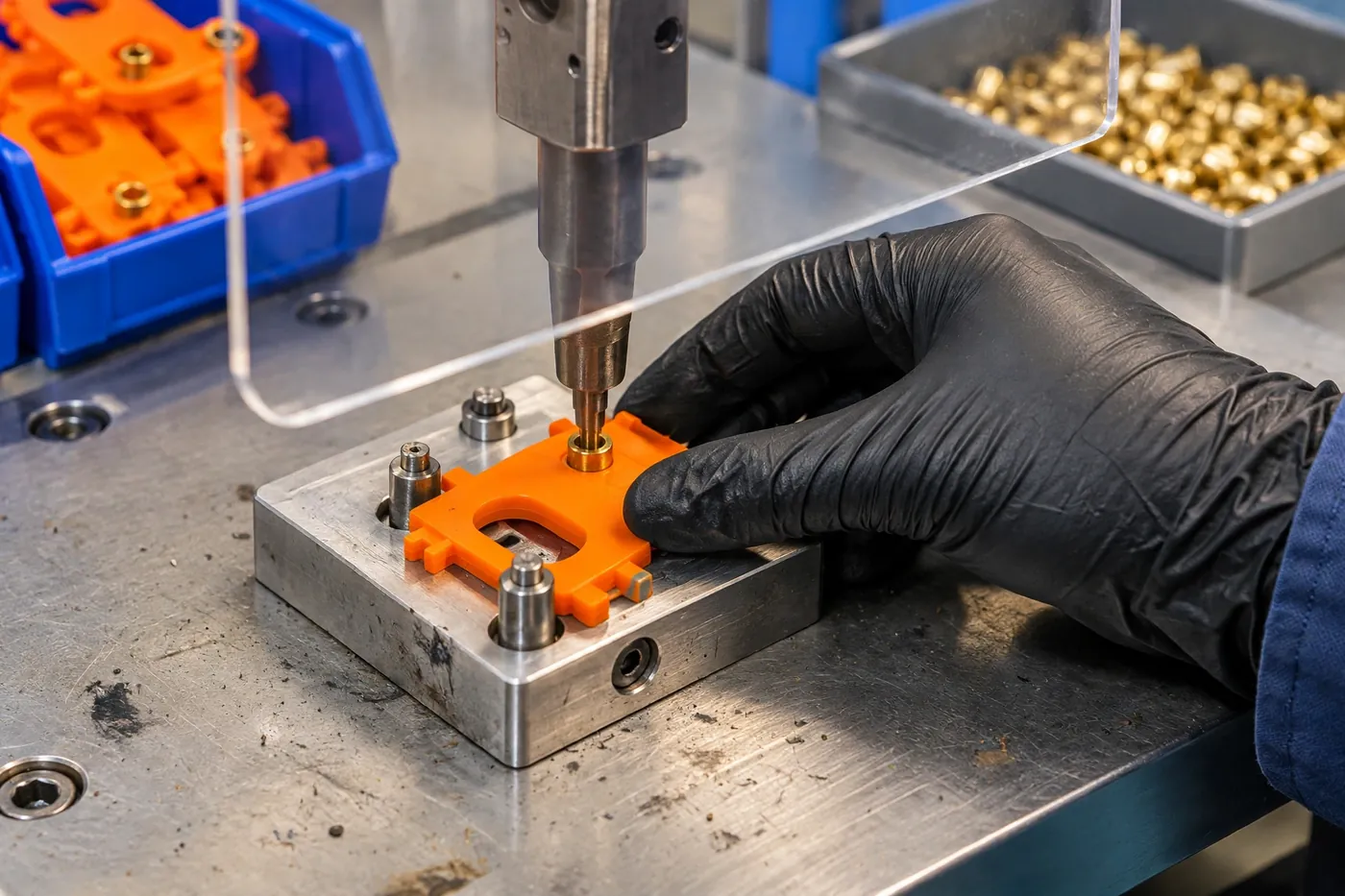
- Heat staking and ultrasonic welding — joining plastic components to each other or to hardware without fasteners; the choice between them is material- and assembly-dependent, and we compare the two in detail in our guide to heat staking vs ultrasonic welding.
- Insert and hardware fitting — threaded brass inserts, screws, rivets and metal reinforcements fitted or moulded in.
- CNC finishing — trimming, drilling and machining where moulded geometry needs post-processing, standard on carbon composite parts.
- Sub-assembly and pack-out — components assembled, fastened, labelled and packed retail- or line-ready, under the same roof as our precision OEM assembly services.
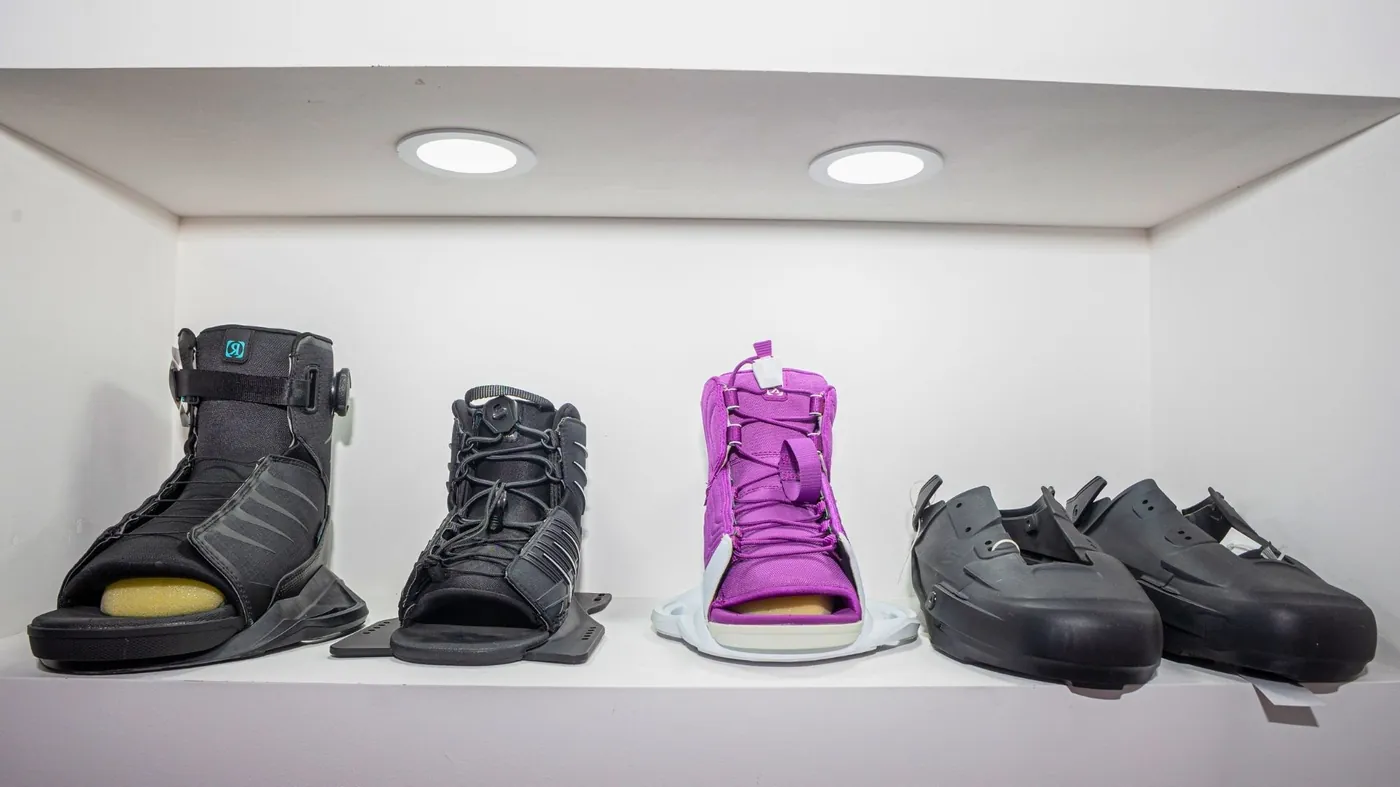
Keeping these operations in one factory is not a convenience — it is a quality decision. When the team that moulds a frame also assembles it, a fit problem is traced to its cause (tool, material or assembly) inside one quality system, instead of becoming an argument between two suppliers.
Stage 6: Quality Testing — What “Good” Actually Means
Sports equipment fails publicly and sometimes dangerously, so testing is written into the programme from the start, not bolted on at the end. A serious quality system for sporting goods covers:
- Dimensional verification — CMM and optical 3D scanning compare production parts to the CAD model; on our programmes, tolerances are verified down to ±0.001 inches with cavity-level traceability, so a problem in one cavity never hides inside a batch average.
- Material verification — resin lot tracking, moisture content and hardness checks before and during production, tying every shipment back to its material records.
- Mechanical testing — impact, flex and fatigue testing on samples from the run: bindings cycled, frames loaded, soles flexed — the product is tested the way athletes will abuse it.
- In-process control (SPC) — statistical monitoring of the moulding process itself, because a stable process is the only guarantee that part ten thousand equals part one.
- First-article and batch documentation — FAI approval before production, inspection records with every batch, so a brand can audit any shipment back to its tool, material lot and process data.
What It Costs and What Drives Lead Time
Two honest generalisations: tooling dominates both cost and timeline, and volume decides which tooling makes sense. A brand expecting a few thousand units validates on aluminium or bridge tooling and keeps unit economics sane; a brand expecting hundreds of thousands invests in hardened multi-cavity steel, and the tooling cost per part falls toward zero. Lead time follows the same logic — design review and quotation are measured in days (our Houston team returns detailed assessments within 12 to 24 business hours for verified files), tooling in weeks (2 to 3 for bridge tools, 4 to 6 for complex steel), and production cycles in seconds per part.
The expensive mistakes are predictable: skipping DFM and paying for tool modifications later; choosing production steel before the design is validated; and splitting moulding and assembly between suppliers who each blame the other when parts do not fit. All three are avoided by the staged process above.
The Haumann Position
We manufacture sporting goods the way this article describes because we run every stage under one system: Houston-based engineering and DFM accountability, tooling and high-volume production at scale, carbon composites and footwear as dedicated lines, and assembly in-house. Programmes start with an NDA and a technical review, and they scale from a 500-part validation batch to full production without changing partners.
Planning a sports product? Send us the design — STEP or IGES file, target material, expected annual volume and the performance the product must survive — and our Houston engineering team will return a manufacturability assessment and a tooling recommendation matched to your volume. Request a technical DFM review or email globalsales@haumann-group.com.
Frequently Asked Questions
What plastic is used in sporting goods?
The plastics used in sporting goods are engineering grades chosen for impact, flex and weather resistance: ABS and polycarbonate for protective shells and housings, nylon (PA6/PA66, often glass-filled) for structural frames and bindings, TPU and TPE for flexible soles, grips and overmoulded parts, and POM for low-friction buckles and adjusters. Carbon fibre composites are used where stiffness-to-weight matters most, such as footwear plates.
How are wakeboard and snowboard bindings manufactured?
Bindings are typically injection moulded from glass-filled nylon for the chassis and frame, because the material holds its shape under repeated load and cold temperatures. The moulded frames are then assembled with straps, buckles, ladders and padding — using secondary operations such as insert moulding, heat staking and hardware fitting — and tested for flex, impact and dimensional fit before release.
How long does it take to manufacture sporting goods?
The timeline is dominated by tooling, not moulding. At Haumann, an engineering assessment of verified files is returned within 12 to 24 business hours; rapid prototype and bridge aluminium tooling is typically machined in 2 to 3 weeks, while complex multi-cavity hardened steel production moulds require 4 to 6 weeks including first-article inspection. Once tooling is approved, production runs scale quickly because each moulding cycle takes seconds.
What is the minimum order quantity for custom sporting goods?
It depends on the tooling route. Bridge and aluminium tooling exist specifically for short runs — Haumann’s Startup OEM Program supports validation batches of roughly 500 to 1,000+ parts — while hardened steel production tooling is justified by high-volume programmes. The right question is not the smallest possible order, but which tooling class matches your expected lifetime volume.
Why is carbon fibre used in sports equipment?
Carbon fibre composites deliver the highest stiffness-to-weight ratio of any common sports material, and their stiffness can be tuned by layer orientation — rigid in one direction, flexible in another. That is why carbon plates appear in elite running shoes, and why carbon components are used in bindings, frames and other parts where energy return and low weight decide performance.
What is overmoulding in sports equipment manufacturing?
Overmoulding moulds a second material directly over a first moulded part — most commonly a soft TPU or TPE layer over a rigid nylon or polycarbonate frame. It creates grips, seals, cushioning and soft-touch surfaces in a single component with no adhesive and no separate assembly step, and it is widely used in footwear, grips, protective gear and binding straps.
How do sporting goods manufacturers test quality?
Quality control in sports equipment manufacturing combines dimensional inspection (CMM and 3D scanning against the CAD model), material verification (resin lot tracking, moisture and hardness checks), in-process monitoring (SPC on pressure and cycle data), and physical testing for impact, fatigue and flex. First-article inspection approves the tool before production, and batch traceability ties every shipment back to its material and process records.
Can one supplier handle both moulding and assembly of sports products?
Yes — and for multi-part products it is usually better. A supplier who moulds the components and also runs secondary operations (heat staking, ultrasonic welding, insert placement, CNC finishing and pack-out assembly) controls the interfaces between parts, so fit problems are solved inside one factory instead of between two vendors.
How do I protect my product design when outsourcing manufacturing?
Start with a signed NDA before any CAD files change hands — at Haumann, a formal B2B NDA is executed before 3D models reach the engineering review desk. Beyond that, work with a supplier whose engineering and contracting sit in your own legal jurisdiction, keep your design files version-controlled, and make sure the agreement states who owns the tooling and the design data.
What files do I need to get a sporting goods manufacturing quote?
A 3D CAD file (STEP, IGES or STL), the target material or its performance requirements, estimated annual volume, and any critical dimensions or test standards. With those, an engineering-led supplier can run a DFM review and return a manufacturability assessment and quote — Haumann’s Houston team returns detailed assessments within 12 to 24 business hours for verified engineering files.