There is no single best plastic for sports equipment. The right material is the one that survives the job the part has to do — and sports parts have harder jobs than most. A binding frame is loaded and unloaded thousands of times. A protective shell has to absorb an impact and stay in one piece. A boot sole flexes in the cold, a handle is gripped with wet hands, and a housing sits in the sun all summer. The material that is right for one of those jobs is often wrong for the next.
The short answer, before the detail: structural frames, bindings and load-bearing hardware are usually glass-filled nylon (PA66-GF30); protective shells are usually impact-modified polycarbonate; grips, soles and soft-touch surfaces are usually TPU or TPE, often overmolded onto a rigid frame; housings and covers are usually ABS or PC/ABS; buckles and adjusters are often POM; and the parts where stiffness-to-weight decides performance — elite footwear plates, high-end frames — use carbon fiber composites. The rest of this guide explains why, what each material demands from the mold and the process, and how to choose between them without guessing.
If you want the manufacturing process behind these materials — design review, tooling, molding, secondary operations and quality testing — Haumann’s guide How Sporting Goods Are Manufactured walks through all six stages. This guide does not repeat it. It answers the question that comes before the process: which material, for which part, and what to check before you commit to tooling. The material scope, capabilities and lead times below come from Haumann’s sports and outdoor products page.
What sports parts must survive
A sports part fails in ways that a housing on a desk never will. Five demands decide the material, and they usually arrive together.
Impact. Drops, collisions, and the shock of a landing all hit the part at once. The material has to absorb energy without cracking. For protective gear, it also has to absorb energy without passing the full force through to the wearer. Impact resistance is the first filter for shells, guards and frames. That is why impact-modified grades exist: the base polymer is toughened specifically for this job.
Weather and UV. Outdoor gear lives outside. Sunlight, rain, temperature swings and, in winter sports, sustained cold all attack the material over time. UV exposure degrades many plastics on the surface first. The part looks fine until it is not. So a material chosen for an indoor product cannot simply move outdoors. Specify the part for its real environment, not for a lab shelf.
Moisture. Water is a working condition for sports gear, not an accident. Rain, sweat, snow and washing all put moisture into the picture. Some materials absorb it and change dimension or strength as they do. Others resist it almost completely. Design for that difference. Do not discover it in the field.
Fatigue and repeated load. A sports part is rarely loaded once. Bindings flex, boot shells bend, athletes open and close buckles, and soles strike the ground thousands of times. The material has to hold its shape and strength across that cycling. The sports page calls this fatigue resistance and load cycling. A material that is strong once but weakens with repetition is the wrong choice for a part that takes hard use.
Weight. In sports, weight is performance. Every gram saved in a frame, a shell or a plate is a gram the athlete does not carry. But that saving counts only if you do not give away strength and stiffness to achieve it. That trade drives material choice toward glass-filled nylons and carbon composites: more performance per gram, not simply less material.
Two more demands sit behind those five. Cosmetic quality matters because sports products are consumer-facing: the surface, color and finish are part of the product, and a part that looks cheap is a part that does not sell. Sports products often follow ASTM performance standards. And repeatability matters because a sports program is a production program: the ten-thousandth part has to match the first, in dimension and in behavior. The material decision therefore shapes the tooling and process decisions that follow it.
The materials at a glance
This table is the whole guide to the best plastic for sports equipment on one page. Each material below gets its own section, but if you only read one table, read this one.
| Material | Where it is used | What it does best | Watch out for |
|---|---|---|---|
| PA66-GF30 (glass-filled nylon 66) | Structural frames, bindings, load-bearing hardware | Strength, stiffness and wear resistance; holds shape under repeated load and cold | Fiber orientation affects shrinkage and warpage; absorbs moisture — drying and DFM matter |
| Polycarbonate (PC), impact-modified | Protective gear shells, guards, housings | Impact resistance and toughness for parts that must not crack | Chemical exposure and stress cracking must be checked for the application |
| TPU / TPE | Grips, soles, seals, soft-touch surfaces, overmolding | Flexibility, grip and sealing; bonds to rigid frames in overmolding | Grade selection drives feel, durability and bond to the substrate |
| ABS | Housings, covers, non-structural parts | High strength for general use, good finish, straightforward processing | Not the choice for heavily loaded or impact-critical structural parts |
| PC/ABS | Enclosures and housings needing toughness and finish | Toughness of PC with the processability and finish of ABS | Chemical exposure and stress cracking must be checked for the application |
| POM (acetal) | Buckles, adjusters, low-friction moving parts | Low friction and dimensional stability in small precision parts | Not a structural material for heavily loaded frames |
| Carbon fiber composites | Elite footwear plates, high-end frames, stiffness-critical parts | Highest stiffness-to-weight; stiffness tunable by layer orientation | Cost and process complexity; needs composite consolidation expertise |
Every material in this table is one Haumann lists or uses for sports and outdoor work, and each one is a candidate for the best plastic for sports equipment. The exact commercial grade, its certificates and its lot traceability are always specified per program — a material family name is not a specification, and swapping grades mid-program can invalidate the evidence behind a product file.
PA66-GF30: the structural workhorse
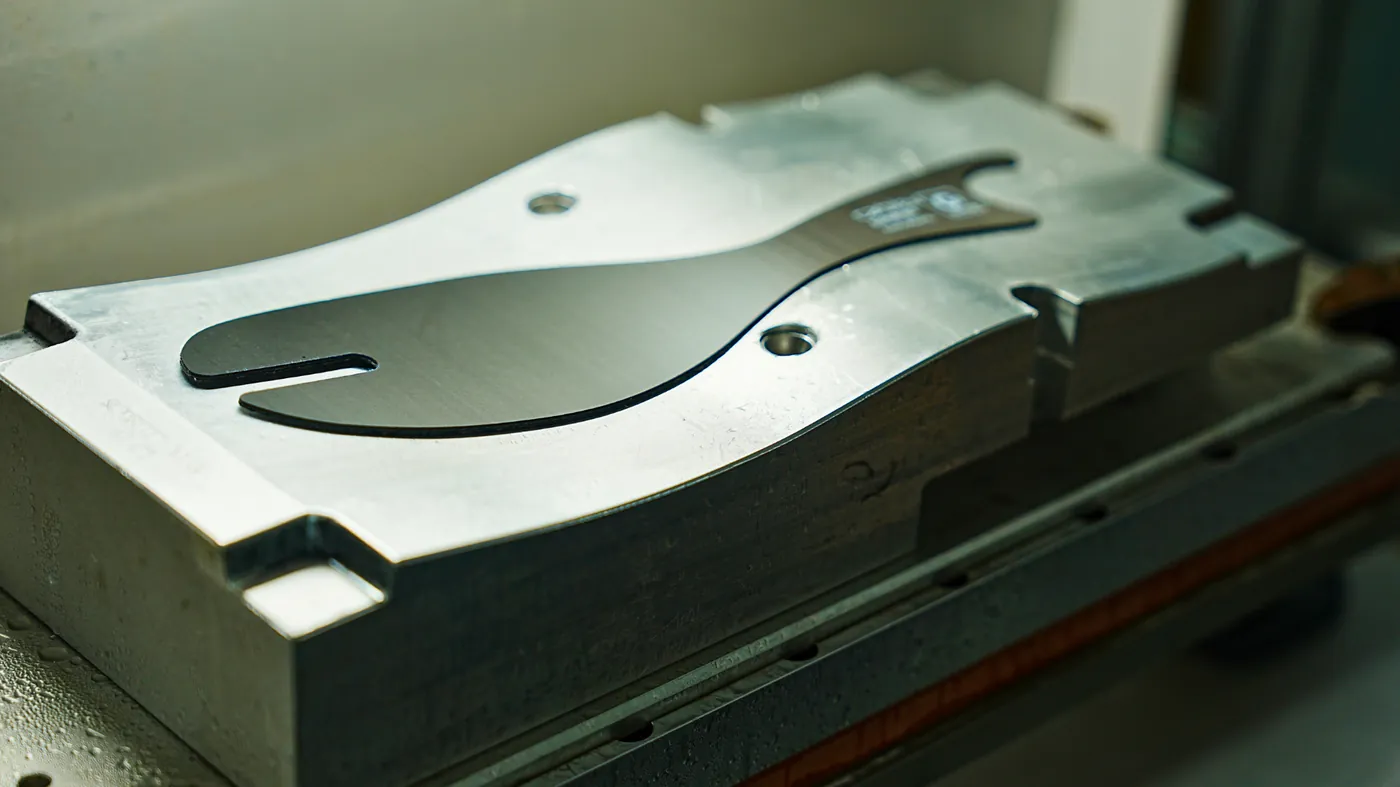
When a sports part has to carry load, PA66-GF30 is usually the first material to consider as the best plastic for sports equipment. It is nylon 66 reinforced with glass fiber — the “GF30” means 30% glass fiber by weight — and the fiber is what changes the job it can do. Unfilled nylon is tough and flexible. Glass-filled nylon is stiff, strong and wear-resistant, which is what a binding chassis, a boot frame or a piece of load-bearing hardware needs when athletes load it again and again.
Haumann’s sports page lists glass-filled nylon 66 for extreme structural hardware, and the same material appears across Haumann’s high-volume work for structural brackets and load-bearing parts. The reason is consistent: the glass fiber raises stiffness and strength and improves wear resistance, so the part holds its shape under repeated load and in cold conditions — exactly the fatigue and load-cycling behavior the sports page’s wakeboard-boot engineering section is built around. For general background on the process, see Plastics Technology’s injection molding topic hub.
Three things decide whether PA66-GF30 delivers that performance. First, fiber orientation. The glass fibers line up with the flow of molten plastic as it fills the mold, so shrinkage and warpage follow the fiber direction. Gate placement therefore has to be planned with fiber flow in mind, not just with fill in mind — the same point Blog #6 makes for high-volume work. A gate in the wrong place can put a weld line or a weak direction exactly where the part is loaded hardest. That is a DFM decision. Make it before anyone cuts steel.
Second, moisture. Nylon absorbs moisture from the air, and that changes its behavior. Dry the material before molding, and make the drying and handling discipline part of the program — do not leave it to chance. This is also why you should specify the material by exact commercial grade, collect its certificates and plan lot traceability from the start: two grades with the same family name can behave differently, and the product file has to show which one is in the part.
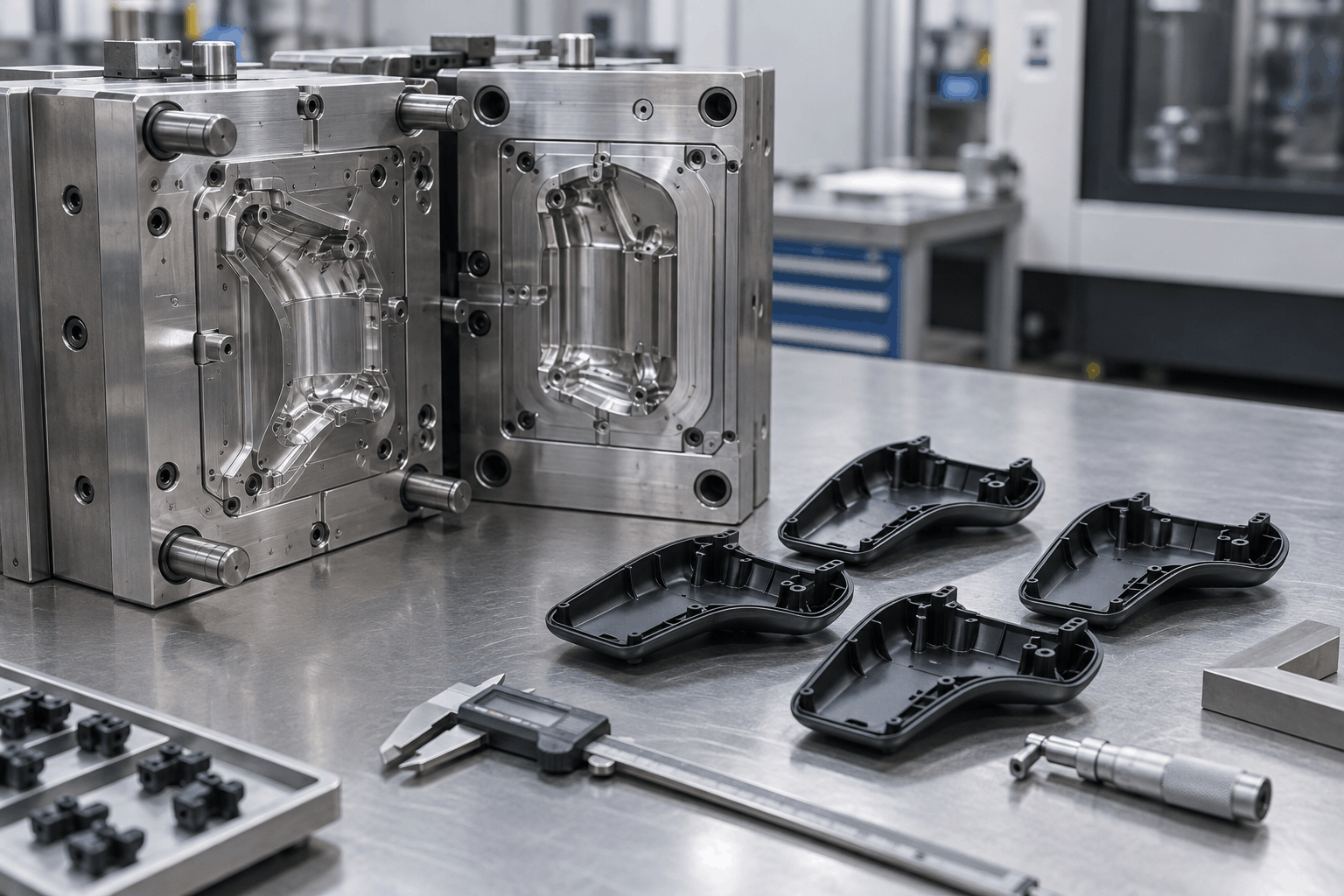
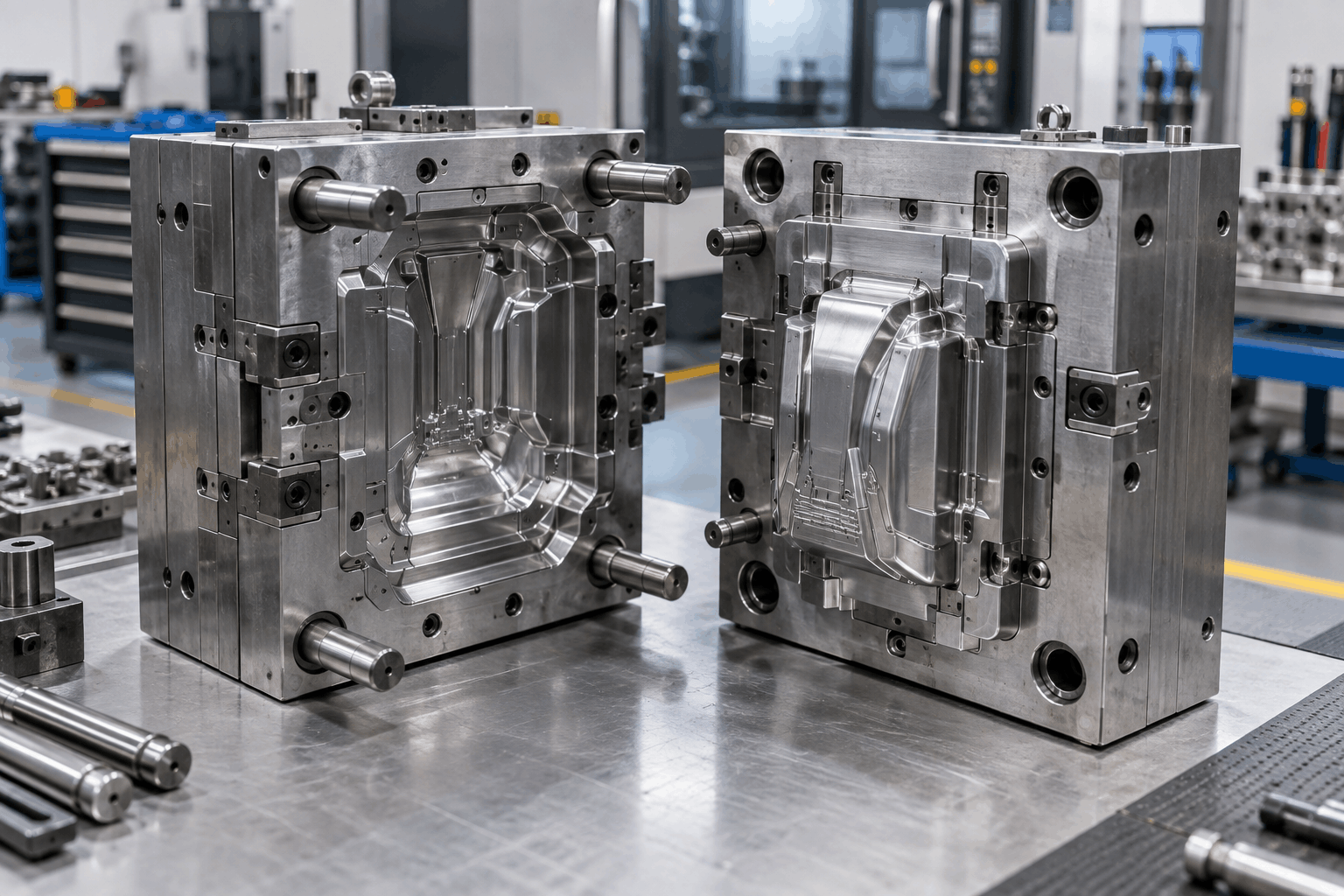
Third, tooling. PA66-GF30 is abrasive — glass fiber wears steel — so build the tool for it. Haumann’s sports work uses multi-cavity hardened steel Class 101 tooling, the highest tooling classification, built for long production life. A buyer should ask what steel and what wear protection the tool carries for a glass-filled program, because a tool that wears early is a program that drifts out of tolerance.
PA66-GF30 is not the answer to every sports part. It is the answer to the structural ones: frames, bindings, chassis, hardware that carries load. For shells that must absorb impact, or grips that must flex, the next sections are the better fit.
Polycarbonate: the protective shell
Polycarbonate is the material for parts that must take a hit and stay in one piece. For the best plastic for sports equipment in protective roles, Haumann’s sports page lists impact-modified polycarbonate for protective gear shells. The reason is straightforward: polycarbonate is exceptionally tough for its weight, and the impact-modified grades are toughened further for exactly this job. A helmet component, a guard, a protective housing — the parts whose whole purpose is to stand between an impact and the wearer — are where polycarbonate earns its place.
The word “impact-modified” matters. A base polymer can be strong in a slow pull and brittle in a fast impact, and sports impacts are fast. The modified grade is formulated so the part absorbs energy instead of cracking, which is what turns a material property into a safety property. That is also why the grade has to be specified exactly: “polycarbonate” on a drawing is not enough, because the impact behavior depends on which grade, and on how it was processed.
Processing matters as much as the grade. Polycarbonate is sensitive to stress cracking from chemical exposure — cleaners, adhesives, skin products, the chemicals a sports part meets in real use — so the application has to be checked against what the part will actually touch. Drying matters too, and so does mold temperature and cooling: a shell that looks right but carries molded-in stress is a shell that can crack later, under a load it should have survived. This is the kind of risk a DFM review is meant to catch, and Haumann’s sports page puts that review — with mold flow simulation, wall thickness evaluation, gate positioning and warpage prediction — at the front of every RFQ, run from Houston.
Polycarbonate also appears blended with ABS as PC/ABS, covered in the section below. The pure grade is for the impact-critical shell; the blend is for the housing that needs toughness plus a good finish. Knowing which one the part needs is a design conversation, not a catalog choice.
TPU and TPE: grip, flex and overmolding
Not every sports surface should be hard. For the best plastic for sports equipment in grips, soles, seals and soft-touch areas, the material needs to flex, to grip when wet, and to cushion. That is the job of thermoplastic polyurethane (TPU) and thermoplastic elastomers (TPE). Haumann’s sports page lists flexible TPU overmolding for handles, and the existing sports guide lists TPU and TPE for flexible soles, grips and overmolded parts. The pattern is the same in both: the soft material is where the athlete touches the product.
Overmolding is how the soft and hard materials become one part. A second material — most commonly a soft TPU or TPE layer — is molded directly over a first molded part, usually a rigid nylon or polycarbonate frame. It creates grips, seals, cushioning and soft-touch surfaces in a single component, with no adhesive and no separate assembly step. That matters for sports gear because a grip that is glued on can peel, and a seal that is fitted separately can shift. An overmolded grip is part of the component, not an accessory to it.
The bond is the engineering. Overmolding only works if the soft material bonds properly to the rigid substrate, and that bond depends on the material pair, the mold design and the process — temperature, timing, surface preparation. Grade selection drives feel, durability and bond strength together: a TPU that feels right but bonds weakly is a field failure waiting to happen, and a TPU that bonds well but feels wrong is a product nobody wants to hold. Both have to be right, and both are decided in the DFM review, not on the production floor.
TPU and TPE also appear on their own, not only as overmolds. Footwear soles and flexible components use them for flex and energy return, and seals use them where a part has to close against water or dust. In each case the grade is chosen for the job — hardness, flexibility, wear resistance — and the tool and process are built around that grade. As with every material in this guide, the exact grade is specified per program, with certificates and traceability, because “TPU” alone describes a family, not a part.
ABS and PC/ABS: housings that have to look right
High-strength ABS is Haumann’s sports-page material for general housings and covers — the parts that protect what is inside and present the product to the buyer. ABS is straightforward to process, takes a good finish, and is strong enough for parts that are not carrying structural load. For the best plastic for sports equipment in a housing, a cover or an enclosure that needs to look right and survive normal handling, ABS is often the honest, economical choice.
PC/ABS is the step up when the housing also has to be tough. It combines the toughness of polycarbonate with the processability and finish of ABS, which is why Haumann lists it for enclosures and covers that need both. A consumer-facing housing on a sports device — one that will be dropped, knocked and handled daily — is the classic PC/ABS part: tough enough to survive, clean enough to sell.
The watch-out for both is the same as for polycarbonate: check chemical exposure and stress cracking for the application. Sports housings meet sweat, sunscreen, cleaners and adhesives, and a housing that cracks around a fastener or a seam is a warranty problem, not a cosmetic one. That check belongs in the material selection conversation, before the grade is frozen.
The other point is about honesty in selection. ABS and PC/ABS are not structural materials, and they should not be sold as such. If a part carries load, flexes under cycling or holds a tight tolerance across thousands of cycles, it belongs in PA66-GF30 or a composite — not in a housing material chosen for its finish. A good material guide says no to the wrong material as clearly as it says yes to the right one.
POM: the small part that has to move
POM — polyoxymethylene, also called acetal — is the quiet material in this guide, and for the best plastic for sports equipment in small moving parts, it is the one to reach for. It does not carry the frame or absorb the impact. It does the small, precise job: buckles, adjusters, clips and low-friction moving parts. Haumann’s own sports guide lists POM for exactly that — low-friction buckles and adjusters — and the reason is that POM slides cleanly and holds its dimensions in small precision parts.
That combination matters more than it sounds. A buckle that sticks, an adjuster that binds, a clip that wears loose — each one is a small part that ruins a good product. POM’s low friction and dimensional stability are what keep those parts working across thousands of cycles, and its precision molding behavior is what keeps them interchangeable. It is a reminder that material selection is not only about the big structural parts: the small moving parts have their own material, and choosing it well is part of the same conversation.
POM is not a structural material for heavily loaded frames, and this guide does not present it as one. Its place is the mechanism, and it should be specified there — by grade, like everything else.
Carbon fiber composites: stiffness where it decides performance
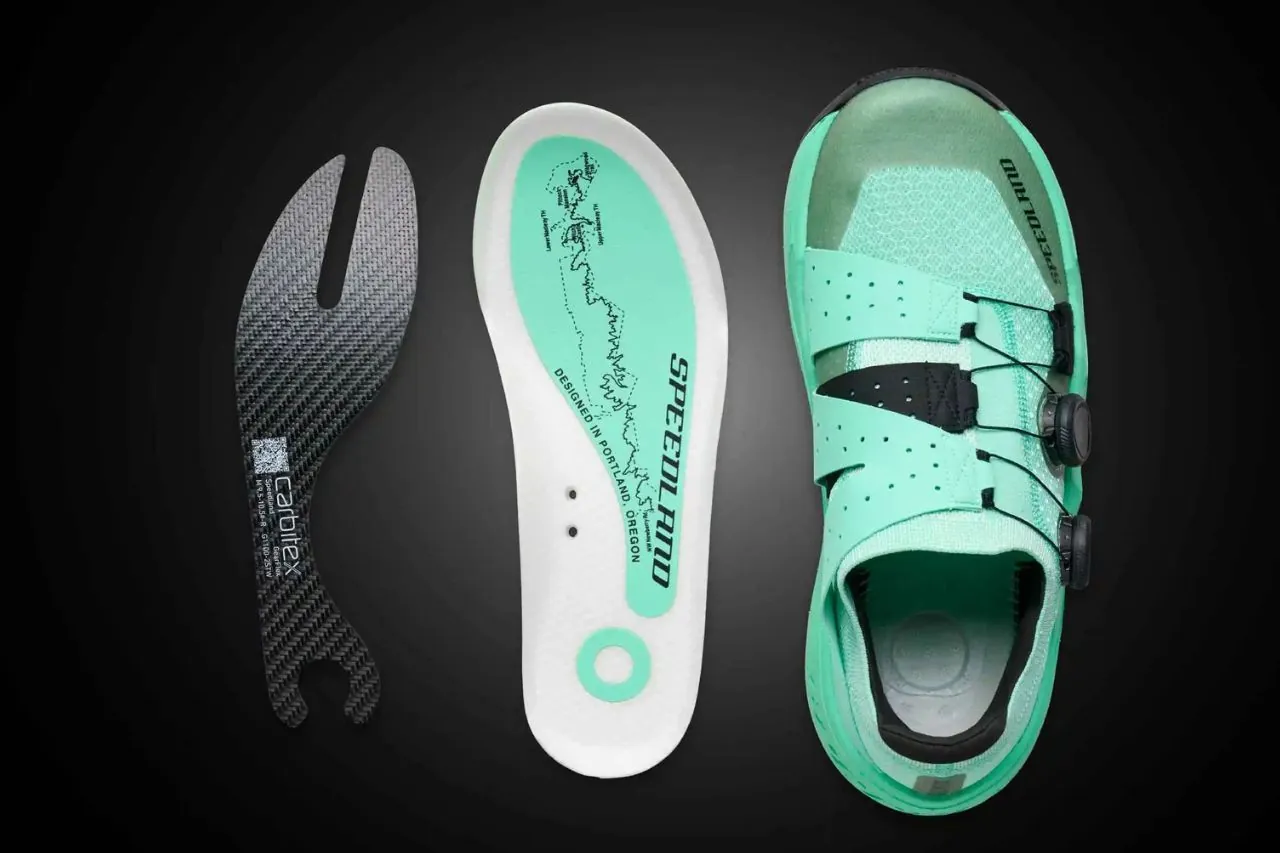
Carbon fiber composites are the most specialized material in this guide, and the most powerful where they fit. For the best plastic for sports equipment at the elite end, Haumann’s sports page lists structural carbon fiber consolidation as a core capability, and the footwear work — carbon fiber composite layers for energy return and rigidity control in elite running and ski boots — shows where it is used: the parts where stiffness-to-weight decides performance.
The advantage is the ratio. Carbon fiber composites deliver the highest stiffness-to-weight of any common sports material, and their stiffness can be tuned by layer orientation — rigid in one direction, flexible in another. That is why carbon plates appear in elite running shoes and why carbon components are used in bindings and frames where energy return and low weight matter. A molded plastic part is the same in every direction; a composite can be engineered direction by direction, which is a different kind of design freedom.
That freedom comes with process demands. Carbon fiber work needs composite consolidation expertise — the team has to place, orient and consolidate the layers correctly, and engineer the interface with molded plastic, not assume it. Haumann’s carbon work covers exactly that: structural carbon fiber composite layers consolidated with the molding program, including overmolding carbon composites with flexible TPU or rigid nylon resins where the application needs it. A buyer considering carbon fiber should ask how the composite and the molding are integrated, because a carbon plate that is not properly consolidated or properly joined to the rest of the part is worse than a simpler material done well.
Carbon fiber is not for every sports program. It is for the parts where performance justifies the complexity — elite footwear, high-end frames, stiffness-critical components. For the rest of the product, the molded materials in this guide do the job better and simpler. Knowing which parts are carbon parts is itself part of the material decision.
When sports materials fail: the failure modes to design against
Most material failures in sports gear are not mysteries. Each one points to a cause — a wrong grade, a missed environmental demand, a process step skipped — and each one should become rarer as a program matures, because the team engineers the cause out. For the best plastic for sports equipment, these are the failure modes sports buyers ask about most, and what prevents them.
| Failure mode | What you see | Typical cause | Prevention |
|---|---|---|---|
| UV degradation | Surface chalking, embrittlement, loss of strength outdoors | Material not specified for outdoor exposure | Choose a UV-suitable grade and design for the real environment; verify outdoor exposure in the material conversation |
| Moisture uptake | Dimensional change, strength loss in nylon parts | Nylon absorbing moisture without drying or design allowance | Drying discipline before molding; grade and design that account for moisture |
| Fatigue cracking | Cracks after repeated flexing or loading | Material or gate placement ignoring load cycling | Fiber-orientation analysis in DFM; gate and design that respect the load path |
| Impact fracture | Part cracks or shatters on a hit | Wrong grade for impact; molded-in stress; cold conditions | Impact-modified grade for shells; stress-free processing; cold-performance check |
| Cold brittleness | Part stiffens and cracks in winter use | Material not specified for low-temperature service | Confirm the grade’s cold behavior for winter sports applications |
| Wear and abrasion | Surfaces wear, grips lose texture, moving parts loosen | Soft grade in a wear position; no wear-resistant specification | Wear-resistant grade where the part rubs; POM for low-friction moving parts |
| Bond failure (overmolding) | Soft layer peels from the rigid frame | Wrong material pair; bond not validated | Material-pair and bond validation in DFM; grade selection for feel and bond together |
Notice the pattern, the same one Blog #6 found at high volume: most prevention happens before production — in material selection, DFM, tooling and process setup. Inspection confirms that prevention worked. A supplier who talks mainly about final inspection is describing the most expensive and least reliable way to run a sports program.
How to choose the best plastic for sports equipment: a material selection checklist
Use this list before you freeze a material for a sports part. It is the conversation to have with your supplier about the best plastic for sports equipment, not a form to fill in alone.
- Name the job first: what does this part carry, absorb, flex, seal or protect — and what happens if it fails? The job decides the material, not the catalog.
- List the environment honestly: indoor or outdoor, sun, rain, snow, sweat, cold, chemicals it will touch. A material chosen for the wrong environment is a field failure.
- Separate structural from cosmetic: load-bearing parts need PA66-GF30 or composites; housings need ABS or PC/ABS; grips need TPU/TPE. Do not ask one material to do another’s job.
- Ask about fiber direction: for any glass-filled part, ask how gate placement accounts for fiber orientation and where the weld lines will fall.
- Ask about drying and handling: for nylon, ask how the material is dried and handled — and what happens to the part if it is not.
- Ask about the bond: for any overmolded part, ask how the material pair and the bond were validated, not just that overmolding is offered.
- Ask about cold and UV explicitly: if the product is used outdoors or in winter, ask for the grade’s behavior there by name — do not assume it.
- Specify by grade, not by family: the exact commercial grade, its certificates and its lot traceability, agreed before tooling — not “nylon” or “TPU” on a drawing.
- Match the test to the failure: ask what testing proves the material for this part — CMM and 3D scanning for dimensions, destructive stress testing for strength, and batch traceability that ties every shipment back to its material and process records.
- Run it through DFM: a material choice is not final until the DFM review has checked wall thickness, gates, fiber flow, warpage and the tooling that will make it.
Haumann’s sports program follows the same order the material decision needs: a DFM review and mold flow simulation from the Houston engineering team on every RFQ, tooling matched to the material — including hardened steel Class 101 tools for glass-filled and high-volume programs — and quality evidence (CMM, optical 3D scanning, destructive stress testing, cavity-level batch traceability) that follows the part into production. If a supplier cannot walk you through those steps for your material, the program is not ready to commit to a grade — however good the material sounds on a data sheet.
How to choose a sports molding partner
Use this checklist when you compare suppliers for the best plastic for sports equipment. The best partner will answer every point with evidence, not adjectives.
- Ask for a written DFM review with specific design and material changes and reasons before you commit to tooling — and ask what changed as a result of it.
- Ask which exact grades are proposed for each part, and why — then ask for the certificates and lot traceability that come with them.
- Ask how fiber orientation, gate placement and cooling were analyzed for glass-filled parts, and how they will be proven at sampling.
- Ask what happens to nylon parts in your product’s real conditions — moisture, cold, repeated load — and how the program accounts for it.
- Ask how overmold bonds are validated, and what happens if a bond fails in testing.
- Ask what testing the program includes: CMM, optical 3D scanning, destructive stress testing, and what batch traceability looks like in practice.
- Confirm the tooling class for the program — aluminum or bridge tooling for validation batches, hardened steel Class 101 for production — and the lead time for each.
- Confirm who owns project communication, where they sit, and how changes are documented — and confirm that proprietary CAD models and tool designs are protected under NDA before review, as Haumann describes.
- Check that certificates match the scope: ISO 9001 discipline is valuable, but it is not a substitute for the evidence your own product file needs.
- Compare total program cost — tooling, unit price, finishing, freight and the cost of a quality escape — not unit price alone.
In short: the best plastic for sports equipment is the one chosen for the part’s real job, in its real environment, with the tooling and testing to prove it. Choose the partner who proves control at those stages, and the material decision becomes the most predictable part of your program. If you are preparing a sports part and want the material decision made properly, send the design for an engineering-led DFM review and get a manufacturing plan you can put in front of your own quality team with confidence. Start with Haumann’s sports and outdoor products page, or contact the Houston team at globalsales@haumann-group.com or +1 (832) 497-0809.
Short, direct answers to the questions engineers and sourcing teams ask most often about sports materials. These questions are different from the existing sports guide’s FAQs — that guide covers the manufacturing process; this guide covers the material decision.
Frequently Asked Questions: What Plastic Is Best for Sports Equipment?
Start with the job, not the catalog: what the part carries, absorbs, flexes or protects, and the environment it lives in — impact, UV, moisture, cold, repeated load. Then match the material to that job: PA66-GF30 for structural parts, polycarbonate for protective shells, TPU/TPE for grips and soles, ABS or PC/ABS for housings, POM for buckles, carbon fiber where stiffness-to-weight decides performance. Specify the exact grade, and run the choice through a DFM review before tooling.
Because the 30% glass fiber makes nylon stiff, strong and wear-resistant, so the part holds its shape under repeated load and in cold conditions. It is the standard choice for binding chassis, boot frames and load-bearing hardware. It needs care: fiber orientation must be planned in DFM, and the material must be dried before molding because nylon absorbs moisture.
When the part must absorb an impact and stay in one piece — helmet components, guards, protective shells. Impact-modified polycarbonate is toughened specifically for that job. The exact grade must be specified, and chemical exposure and stress cracking must be checked for the application, because a shell that looks right but carries molded-in stress can crack later under a load it should have survived.
It molds a soft TPU or TPE layer directly over a rigid frame, creating grips, seals and soft-touch surfaces in a single component with no adhesive and no separate assembly step. The grip becomes part of the component instead of an accessory that can peel. The bond between the soft layer and the rigid substrate has to be validated — grade selection drives feel, durability and bond strength together.
UV degrades many plastics on the surface first — the part can look fine while losing strength. That is why outdoor gear needs a material specified for its real environment, not carried over from an indoor product. The UV question belongs in the material selection conversation, before the grade is frozen.
Nylon absorbs moisture from the air, and that changes its dimensions and behavior. The material must be dried before molding, and the program needs drying and handling discipline plus a design that accounts for moisture. This is one reason the exact grade, its certificates and its lot traceability are specified per program.
Because carbon fiber composites deliver the highest stiffness-to-weight of any common sports material, and their stiffness can be tuned by layer orientation — rigid in one direction, flexible in another. That is why carbon plates appear in elite running shoes and carbon components in bindings and frames where energy return and low weight decide performance. It needs composite consolidation expertise, so it is used where performance justifies the complexity.
ABS is a strong, good-finish material for general housings and covers that do not carry structural load. PC/ABS adds polycarbonate’s toughness to ABS’s processability and finish, so it suits housings that will be dropped, knocked and handled daily. Neither is a structural material — load-bearing parts belong in PA66-GF30 or a composite.
Through the DFM review and mold flow simulation first, then through sampling and inspection: CMM and optical 3D scanning for dimensions, destructive stress testing for strength, and batch traceability tying every shipment back to its material and process records. At Haumann, an engineering assessment of verified files is returned within 12 to 24 business hours, and tooling routes run from bridge aluminum molds in 2 to 3 weeks to complex multi-cavity steel molds in 4 to 6 weeks including first-article inspection.
Project ownership, engineering review and communication are managed by Haumann’s team in Houston, Texas — in Conroe, where presses run from 50 to over 500 tons of clamp force — and production can scale through Haumann’s Asia capacity under one quality standard. That gives US OEM teams a local, accountable partner with global manufacturing capacity behind it.
Start with a DFM review of your part
Share the part design for an engineering-led review covering material choice, manufacturability, tooling strategy and quality planning for your sports program. Explore the scope first on Haumann’s sports and outdoor products page, or contact the Houston team at globalsales@haumann-group.com or +1 (832) 497-0809.