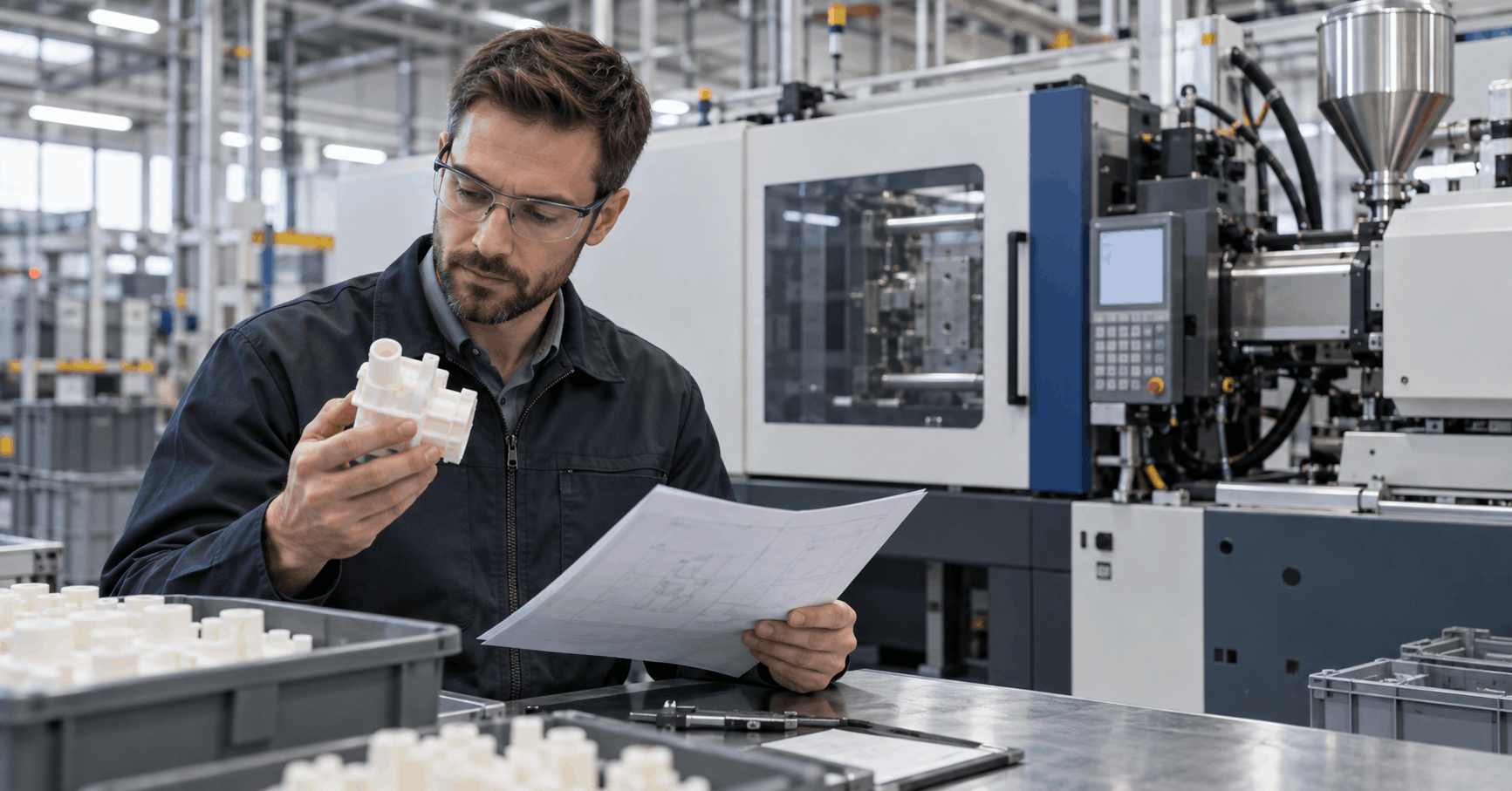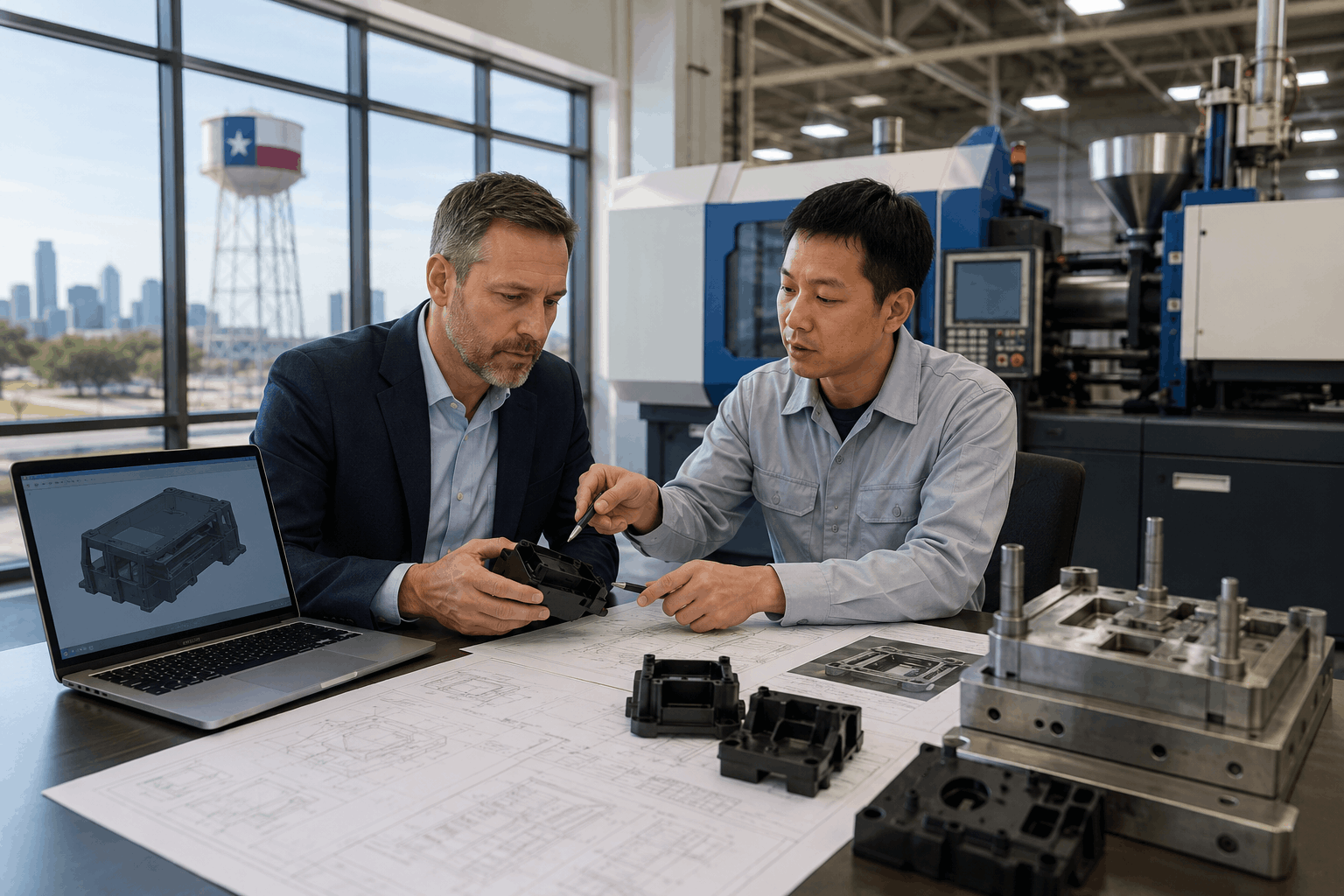
If you are sourcing plastic parts in Texas, one of the first questions that usually comes up is simple: How much will injection molding cost?
The difficult part is that there is no single answer.
A small, straightforward plastic component manufactured in high volume can have completely different economics from a large automotive housing, industrial enclosure, or electronic component that requires complex tooling, engineering plastics, tight tolerances, cosmetic surfaces, and additional assembly.
That is why two injection molding suppliers can review what appears to be the same project and return significantly different quotes.
For Texas OEMs, the situation can be even more nuanced. The manufacturing price is only one part of the equation. Engineering support, tooling strategy, production location, transportation, inventory, lead times, quality control, and the ability to scale production can all affect what a project ultimately costs.
Texas has a broad advanced-manufacturing base spanning automotive, electronics, aerospace, and heavy machinery, creating demand for suppliers that can support everything from product development to repeat production.
So instead of asking only, “What is the injection molding cost per part?”, it is more useful to ask:
What is actually driving the cost of this project, and what can be optimized before production begins?
That is the question this guide will answer.
How Much Does Injection Molding Cost in Texas?
There is no universal price for injection molding in Texas—or anywhere else.
A manufacturer needs to understand the part, material, tooling requirements, production volume, tolerances, quality expectations, and delivery requirements before providing a meaningful estimate.
At a high level, injection molding economics can be divided into upfront costs and recurring production costs.
Upfront costs can include mold or tooling development, engineering, DFM analysis, prototype tooling, validation, and mold modifications. These expenses occur before or during the transition into production and can represent a significant initial investment.
Recurring costs are generated each time the part is manufactured. Resin, machine time, labor, inspection, scrap, secondary operations, assembly, packaging, and other production requirements can all contribute to the finished part cost.
This distinction is especially important when comparing low-volume and high-volume programs.
Imagine a hypothetical mold investment of $30,000. If only 1,000 parts are produced, the theoretical tooling allocation is $30 per part. If 10,000 parts are produced, it becomes $3 per part. At 100,000 parts, it becomes $0.30 per part.
Those figures are purely illustrative. They are not market prices or a HAUMANN quotation.
The point is that the economics of injection molding change dramatically when the same tooling investment is spread across a larger production program.
For a Texas OEM, this means the best manufacturing strategy should be based not only on the first purchase order, but also on the realistic annual demand and expected life of the product.
A Simple Injection Molding Cost Model
One of the easiest ways to understand a molding quote is to separate the costs that happen once from the costs that repeat during production.
A simplified model looks like this:
Total Program Cost = Tooling + Engineering/Setup + (Production Cost Per Part × Quantity) + Secondary Costs + Logistics
And when you want to understand the effective cost per part:
Effective Cost Per Part = Total Program Cost ÷ Total Quantity
This distinction becomes extremely useful when comparing suppliers.
A supplier offering a lower piece price may still produce a higher total program cost if its tooling is substantially more expensive, secondary operations are excluded, or logistics are higher.
10 Factors That Affect Injection Molding Cost in Texas
1. Mold Design and Injection Molding Tooling Cost
For many projects, tooling represents one of the largest upfront investments.
But saying “the mold costs $X” does not explain what is actually behind that number.
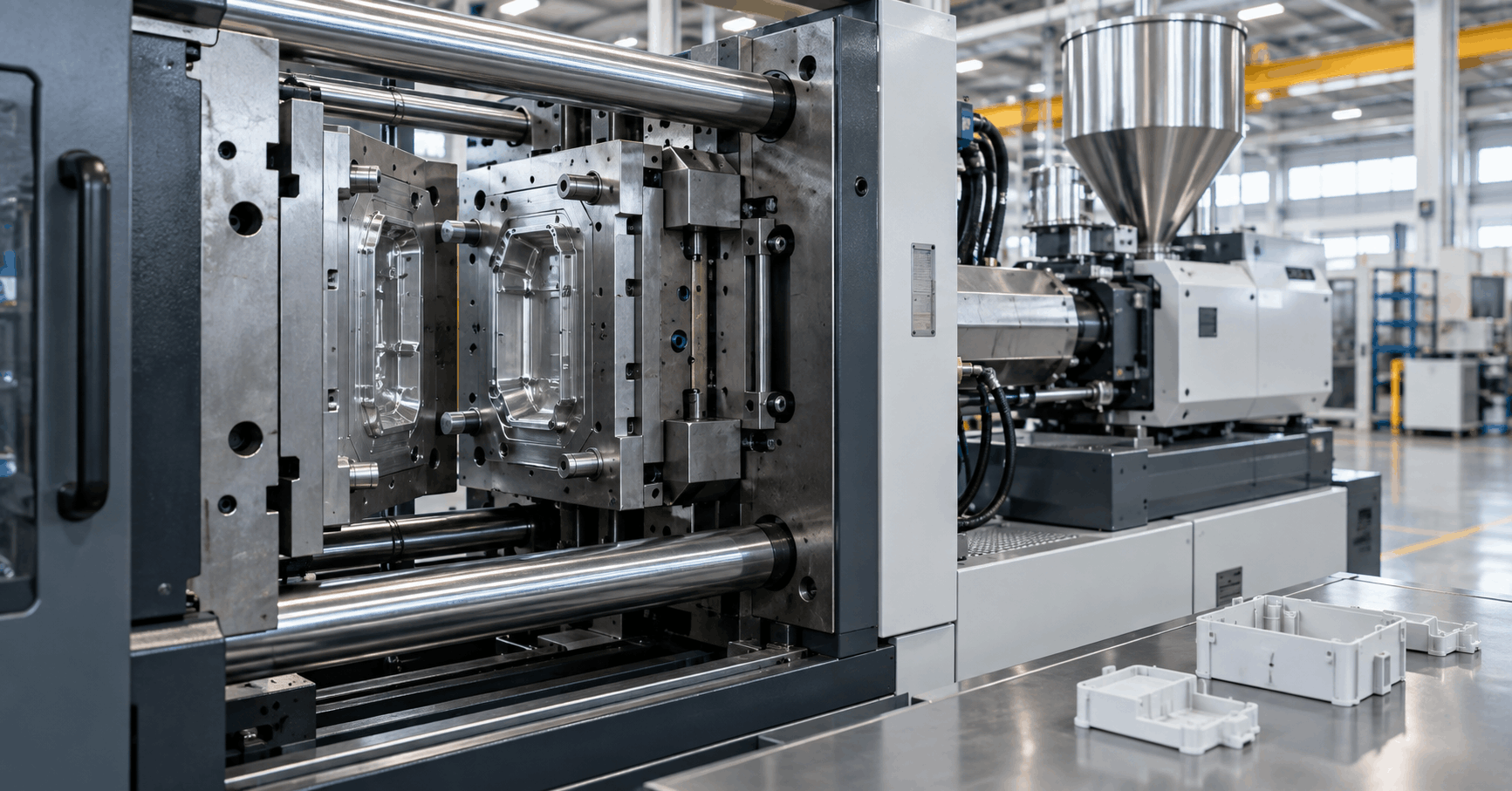
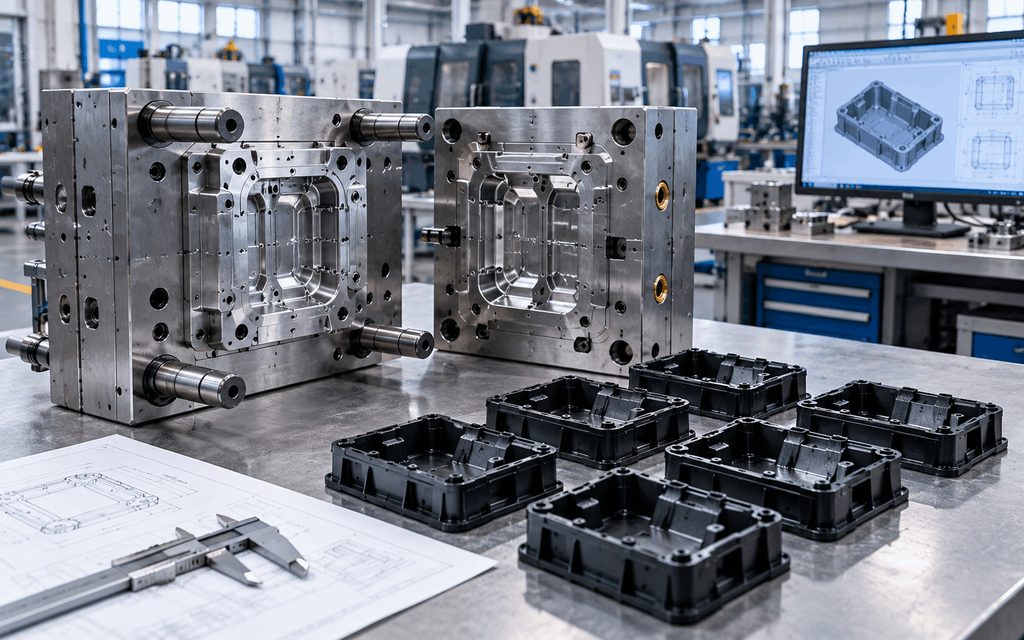
A simple single-cavity mold for a relatively uncomplicated component requires a very different engineering approach from a high-volume production mold with multiple cavities, complex cores, slides, lifters, specialized cooling, precision ejection, and cosmetic surface requirements.
Mold size is one consideration. The number of cavities is another. Steel selection, expected tool life, cooling design, runner configuration, ejection, surface finish, and the complexity of the part all influence the tooling strategy.
For example, an automotive component expected to run for several years may justify a more durable tooling approach than a prototype or short-run component. A low-volume industrial product may not need the same cavity strategy as a consumer product expected to ship hundreds of thousands of units annually.
The important question is therefore not simply, “Who can build this mold for the lowest price?”
It is:
“Is this mold designed appropriately for the production program?”
A cheaper mold can become expensive if it produces inconsistent parts, requires frequent maintenance, limits production capacity, or needs major modifications later.
For OEMs evaluating a manufacturing partner, HAUMANN’s tooling engineering and mold fabrication capabilities provide a useful starting point for evaluating production tooling requirements.
What Does Tooling Cost Mean on a Per-Part Basis?
A useful calculation is:
Tooling Cost Per Part = Tooling Investment ÷ Expected Lifetime Production Quantity
For example, suppose a production mold costs $30,000 and is expected to produce 300,000 acceptable parts over its planned production life.
$30,000 ÷ 300,000 = $0.10 per part
That $0.10 is not the complete part cost. It is simply the tooling allocation.
This is an important distinction because buyers sometimes see a $30,000 mold and assume the tooling makes the part expensive. If the mold supports a large production program, the tooling allocation can become relatively small compared with recurring material and machine costs.
2. Part Size, Weight, and Material Usage
Part size affects injection molding cost in several ways.
Larger components generally require larger molds and may require molding machines with greater clamp force and injection capacity. They can also consume more resin per cycle.
Part weight becomes particularly important at production volumes.
A difference of a few grams may seem insignificant when looking at one component. Multiply that difference by hundreds of thousands of parts and the material impact becomes much more meaningful.
However, size and weight do not tell the entire story.
Wall thickness can influence filling, cooling, shrinkage, cycle time, and dimensional stability. A large thin-walled part may have very different manufacturing requirements from a smaller component with thick sections.
For Texas manufacturers, this can matter when evaluating whether a part should be redesigned before production. Material reduction can sometimes improve economics, but it should never compromise the strength, thermal performance, impact resistance, or other requirements of the finished product.
Material Cost Formula
For a basic estimate:
Material Cost Per Part = Part Weight × Material Cost Per Unit Weight
If the part weighs 80 grams and the effective resin cost is $3.00 per kilogram:
0.08 kg × $3.00 = $0.24 per part
In a real production estimate, the calculation may also need to account for runners, sprues, startup scrap, process scrap, and whether material can be effectively reground or recycled within the approved process.
That is why asking for the effective material consumption per finished part can produce a more meaningful number than looking only at the nominal part weight.
3. Part Complexity and Geometry
Part geometry is one of the areas where an injection molding project can become more expensive without the increase being obvious from the outside.
A simple component with good draft and straightforward ejection may require relatively uncomplicated tooling.
Now add an undercut.
Then add a deep rib.
Then a side hole.
Then a snap fit or threaded feature.
Each feature may be completely reasonable from a product-design perspective, but some can require additional tooling mechanisms or more demanding processing.
Undercuts, for example, can require slides or lifters. Complex cores can increase machining and maintenance requirements. Thin walls can make filling more sensitive. Deep features can affect cooling and ejection.
That does not mean complex geometry should automatically be removed.
If a feature is necessary for the product to work, it should remain.
The goal is to identify unnecessary manufacturing complexity before tooling begins.
This is particularly valuable for Texas OEMs developing products locally while working with a broader manufacturing supply chain. An engineering review before tooling can help reduce the likelihood that a design issue discovered during mold construction turns into a costly revision.
4. Plastic Material Selection
Material selection has a direct effect on plastic injection molding cost, but resin price should not be the only consideration.
Different materials behave differently during molding and provide different levels of strength, stiffness, impact resistance, heat resistance, chemical resistance, dimensional stability, and cosmetic performance.
Common engineering and production materials may include ABS, polypropylene, polycarbonate, PC/ABS, nylon, PBT, TPU, TPE, and glass-filled grades.
The correct choice depends on the application.
For instance, a consumer product may prioritize appearance and impact resistance, while an industrial component may need chemical or temperature resistance. An automotive application may have different performance requirements again.
Processing characteristics matter as well.
Some materials require drying. Some have higher processing temperatures. Reinforced resins can influence tool wear and fiber orientation. Shrinkage behavior can affect tooling and dimensional results.
This means choosing the least expensive resin does not necessarily produce the lowest overall manufacturing cost.
A better question is:
Which material provides the required performance while remaining practical to process at the intended production volume?
That is an engineering decision as much as a purchasing decision.
5. Production Volume and Annual Demand
Production volume can dramatically change the economics of an injection molding project.
The reason is simple: tooling and engineering costs can be distributed over the number of parts produced.
A Texas startup preparing for a few thousand units has a different cost structure from an established OEM expecting hundreds of thousands of components every year.
This is why manufacturers should know the difference between the initial order quantity and the expected annual volume.
Suppose the first purchase order is 5,000 pieces, but the product is expected to reach 250,000 units annually. Selecting tooling purely around the first order could lead to a different decision than selecting tooling for the expected life of the product.
The opposite can also be true.
If demand is uncertain and the product is expected to remain at relatively low volumes, investing heavily in a high-cavity production mold may not make financial sense.
Volume therefore influences not only the per-part cost but also the appropriate tooling strategy.
Tooling Amortization Example
Consider the following simplified comparison:
| Production Quantity | Tooling Investment | Tooling Allocation Per Part |
|---|---|---|
| 1,000 | $30,000 | $30.00 |
| 5,000 | $30,000 | $6.00 |
| 10,000 | $30,000 | $3.00 |
| 50,000 | $30,000 | $0.60 |
| 100,000 | $30,000 | $0.30 |
| 500,000 | $30,000 | $0.06 |
The table demonstrates why the same mold can look expensive for a short production run and highly economical for a long-term program.
The numbers are illustrative, but the relationship is real: higher production volume generally spreads fixed tooling costs across more units.
6. Mold Cavities and Production Strategy
Mold cavity count is closely connected to production volume.
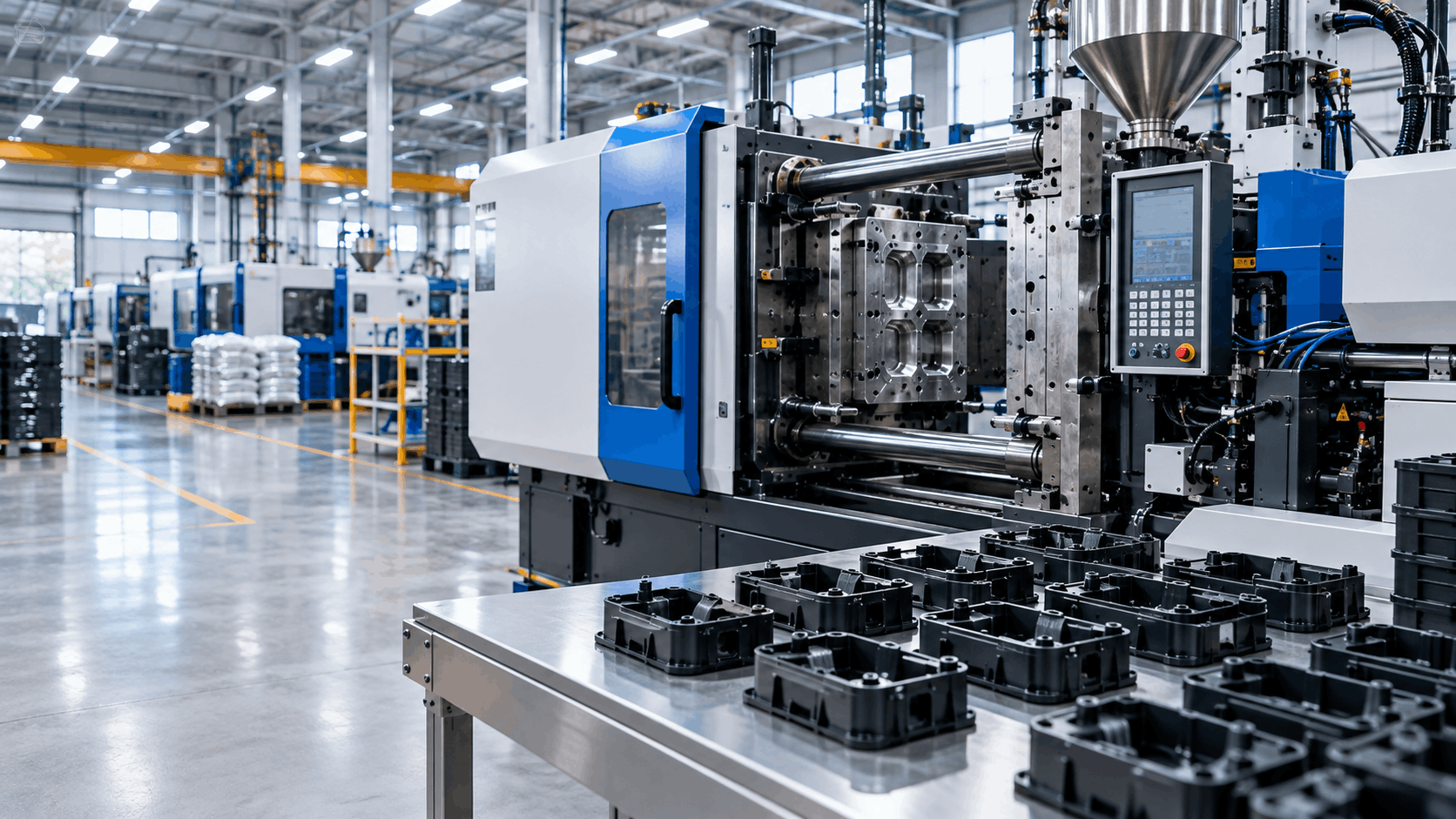
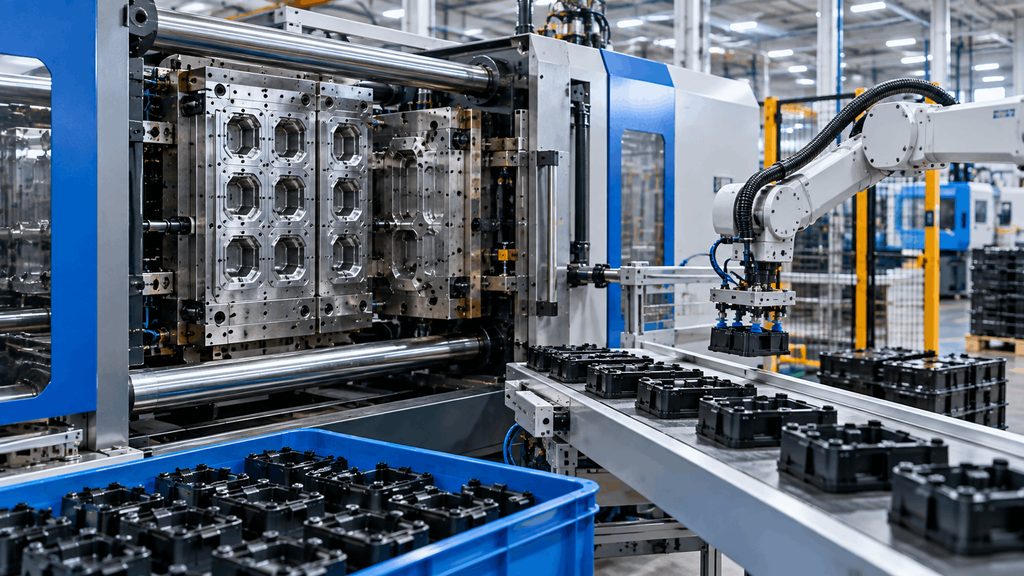
A single-cavity mold produces one part per cycle. A four-cavity mold can potentially produce four parts in the same cycle, assuming the tool and process are designed to do so reliably.
That increased output can improve production efficiency, but it generally comes with a higher initial tooling investment.
The question is therefore not whether four cavities are “better” than one.
The question is whether the additional tooling investment is justified by the production volume.
Single-Cavity vs. Multi-Cavity Economics
| Consideration | Single Cavity | Multi-Cavity |
|---|---|---|
| Initial tooling investment | Usually lower | Usually higher |
| Parts per cycle | Lower | Higher |
| Potential machine efficiency | Lower for high volume | Higher for high volume |
| Tooling complexity | Lower | Higher |
| Cavity balancing requirements | Minimal | More important |
| Best fit | Lower-volume or uncertain demand | Higher-volume programs |
A simplified output calculation is:
Parts Per Hour = 3600 ÷ Cycle Time in Seconds × Number of Cavities × Efficiency Factor
For example, if a four-cavity mold runs a 30-second cycle at a hypothetical 85% operating efficiency:
3600 ÷ 30 × 4 × 0.85 = 408 parts/hour
Again, this is an illustrative calculation rather than a production guarantee. Actual output depends on machine utilization, downtime, rejects, setup time, operator activities, and the specific process.
The important lesson is that cavity count should be evaluated against actual demand, not selected simply because more cavities appear cheaper on paper.
7. Cycle Time and Machine Requirements
Every injection molding cycle takes time.
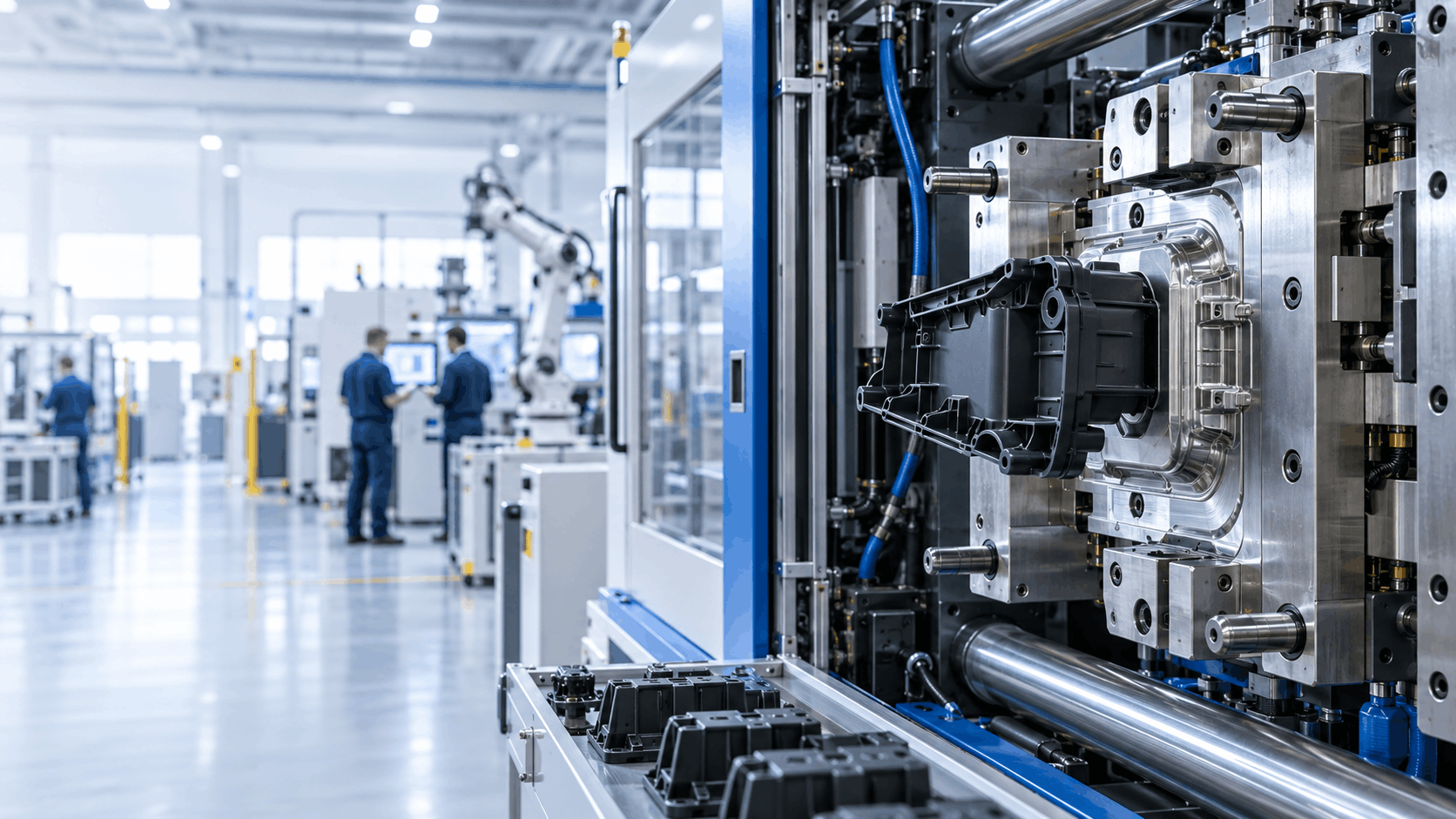
The machine must inject the material, apply the required holding or packing pressure, allow the plastic to cool, open the mold, eject the part, and prepare for the next cycle.
Cooling can be especially important because the molded material needs sufficient time to reach an appropriate condition for ejection.
Part thickness, resin selection, mold cooling, tooling design, and process settings can all influence cycle time.
Machine requirements also matter. The molding machine must have sufficient clamp force and injection capacity for the part and mold.
Now consider the scale of a production program.
If one cycle takes 30 seconds and another takes 35 seconds, the five-second difference may not look significant on a single part. Over hundreds of thousands of cycles, however, it can become a meaningful difference in machine utilization and production cost.
Machine Cost Per Part Formula
A simplified production-machine calculation is:
Machine Cost Per Part = Machine Rate Per Hour × Cycle Time ÷ 3600 ÷ Number of Cavities
Suppose a hypothetical fully loaded machine rate is $75/hour, the cycle time is 30 seconds, and the mold has four cavities:
$75 × 30 ÷ 3600 ÷ 4 = $0.156 per part
If the same mold required 40 seconds instead:
$75 × 40 ÷ 3600 ÷ 4 = $0.208 per part
That difference is only about five cents per part in this simplified example. But at 500,000 parts, the difference becomes approximately $26,000.
That is why cycle time can become a significant long-term cost lever.
8. Tolerances, Surface Finish, and Quality Requirements
Precision costs money when precision is actually required.
The mistake is assuming that every dimension needs the tightest possible tolerance.
If a tolerance controls an important assembly interface, sealing surface, mechanical movement, or functional relationship, tighter control may be essential.
But if a dimension has no meaningful effect on product performance, unnecessarily tight tolerances can increase tooling precision, inspection requirements, process control, and manufacturing difficulty without adding value.
Surface requirements have a similar effect.
A visible exterior housing may need a carefully controlled cosmetic finish, texture, polish, or gloss level. An internal component that is hidden after assembly may have very different requirements.
Texas OEMs should therefore distinguish between functional precision and cosmetic or unnecessary precision when developing their drawings and specifications.
For organizations building formal quality-management processes around production, ISO 9001 provides an internationally recognized framework for quality management systems and continual improvement.
The goal is not to reduce quality requirements.
It is to make sure the requirements are appropriate for the product.
9. Secondary Operations and Assembly
A molded component is not always a finished component.
Depending on the product, it may need trimming, machining, insert installation, welding, painting, printing, laser marking, heat staking, ultrasonic welding, assembly, inspection, or specialized packaging.
These steps can have a major effect on the final manufacturing cost.
Imagine that one supplier quotes an attractive molding price but sends the parts to another facility for assembly. Another supplier has molding and assembly capabilities within the same manufacturing program.
The first supplier may appear cheaper when looking only at the molding line item. But once freight, handling, inspection, supplier coordination, inventory, and assembly are included, the total program economics may look very different.
This is why Texas OEMs should compare finished-part or total-program cost, not only the molding piece price.
An integrated manufacturing partner can sometimes reduce the number of handoffs between suppliers and simplify quality and production management.
HAUMANN’s broader manufacturing platform combines injection molding with tooling, CNC machining, secondary operations, and assembly, giving OEM customers an opportunity to evaluate several production requirements within one manufacturing relationship.
10. Location, Logistics, and Supply Chain
When the target market is Texas, manufacturing location becomes a particularly important part of the cost discussion.
But “Texas versus overseas” is not a simple price comparison.
A manufacturing program has a landed cost, not merely a factory price.
Landed cost can include freight, warehousing, inventory carrying costs, customs or import considerations, quality oversight, supplier management, lead times, and the financial impact of having products in transit.
Houston is particularly relevant because of its role as a major trade and logistics center. Port Houston’s current trade reporting shows significant movement of resins and plastics as well as automotive, machinery, and electronics-related cargo through the region.
For a Texas OEM, proximity can therefore have value beyond transportation distance.
Having engineering and customer support close to the customer can make design reviews, quality discussions, project updates, and production problem-solving easier. At the same time, access to global production capacity can be useful when the project requires higher volumes or specific tooling and manufacturing capabilities.
This is why the best sourcing decision should evaluate:
Piece Price + Tooling + Logistics + Inventory + Quality + Lead Time + Supply-Chain Risk
The lowest factory quote is not automatically the lowest total cost.
How to Calculate Landed Cost for a Texas OEM
This is where a lot of supplier comparisons become misleading.
Imagine Supplier A offers a lower factory price but produces outside the United States. Supplier B offers a higher factory price but provides a different logistics and inventory structure.
Instead of comparing only the factory prices, build a simple landed-cost model.
Landed Cost Per Part = Factory Cost + Freight + Duties/Import Costs + Packaging + Warehousing + Quality/Inspection + Other Direct Supply-Chain Costs
Not every project will have every component.
The important point is to include the costs that actually apply to your program.
For example, consider an illustrative comparison:
| Cost Element | Supplier A | Supplier B |
|---|---|---|
| Factory part price | $1.10 | $1.30 |
| Estimated logistics allocation | $0.22 | $0.08 |
| Additional inspection/handling | $0.10 | $0.04 |
| Inventory carrying impact | $0.08 | $0.03 |
| Estimated landed cost | $1.50 | $1.45 |
Supplier A looks cheaper if you only compare $1.10 with $1.30.
But once the broader supply-chain costs are considered, Supplier B becomes less expensive in this hypothetical example.
The numbers are illustrative, but the purchasing lesson is important:
Always compare equivalent cost structures.
Injection Molding Cost vs. Cost Per Part
One of the most common mistakes in purchasing is to treat the quoted piece price as the complete cost of the program.
It is not.
A more useful way to think about injection molding economics is:
Approximate Per-Part Cost = Material + Machine Time + Labor + Tooling Amortization + Quality + Secondary Operations + Packaging + Allocated Logistics
The exact structure will vary from supplier to supplier.
Illustrative Per-Part Cost Breakdown
Suppose a hypothetical production program has the following economics:
| Cost Component | Example Cost Per Part |
|---|---|
| Material | $0.24 |
| Machine time | $0.16 |
| Direct labor | $0.05 |
| Quality/inspection | $0.03 |
| Secondary operation | $0.08 |
| Packaging | $0.04 |
| Tooling amortization | $0.10 |
| Illustrative production cost | $0.70 |
The $0.70 figure is not a market benchmark. It is simply an example of how a buyer can break down a quote.
This type of model is much more useful than asking whether “$0.70 per part sounds expensive.”
You can ask a better question:
Which component of the $0.70 can realistically be improved without creating another problem somewhere else?
A Practical Injection Molding Cost Calculator Formula
For an initial internal estimate, an OEM can use a simplified formula:
Total Cost = Tooling + Engineering + Setup + [(Material + Machine + Labor + Quality + Secondary Operations + Packaging) × Quantity] + Logistics
Then:
Effective Cost Per Part = Total Cost ÷ Quantity
For example, imagine a hypothetical program with:
Tooling = $30,000
Engineering and setup = $5,000
Recurring manufacturing cost = $0.70 per part
Quantity = 100,000 parts
Logistics and other program costs = $10,000
The calculation becomes:
Total Cost = $30,000 + $5,000 + ($0.70 × 100,000) + $10,000
Total Cost = $115,000
Then:
$115,000 ÷ 100,000 = $1.15 effective cost per part
Notice what happened.
The recurring manufacturing cost was only $0.70 per part, but once the upfront and program-level costs were included, the effective cost became $1.15 per part.
This is why the phrase “part price” needs context.
Why Two Injection Molding Quotes Can Be So Different
It is normal for two qualified injection molding suppliers to quote different prices for the same part.
That does not necessarily mean that one supplier is wrong.
They may simply be making different assumptions.
One manufacturer may recommend a single-cavity mold while another proposes four cavities. One may quote a particular steel grade and tool life while another assumes something different.
One supplier may include engineering, inspection, assembly, packaging, or tooling maintenance in the quotation. Another may list those services separately.
Cycle-time assumptions can differ. Material assumptions can differ. Scrap rates can differ. Production locations can differ.
Even the definition of “tooling cost” can vary.
This is why procurement teams should compare quotations based on what is actually included.
What to Compare in Two Injection Molding Quotes
| Quote Variable | Supplier A | Supplier B |
|---|---|---|
| Tooling cost | ||
| Cavity count | ||
| Mold steel | ||
| Expected tool life | ||
| Material specification | ||
| Part weight assumption | ||
| Cycle-time assumption | ||
| Machine size | ||
| Scrap/reject assumption | ||
| Quality inspection | ||
| Secondary operations | ||
| Assembly | ||
| Packaging | ||
| Freight/logistics | ||
| Engineering/DFM | ||
| Tool maintenance | ||
| Lead time |
This simple comparison can reveal why two quotations that initially look very different may actually be much closer—or much farther apart—than the headline numbers suggest.
Don’t compare the numbers until you understand the assumptions behind them.
How DFM Can Help Control Injection Molding Cost
One of the best opportunities to influence manufacturing economics happens before the mold is built.
Once tooling has been machined, assembled, tested, and validated, changing the product can become significantly more complicated than changing the CAD model.
Design for Manufacturability, or DFM, gives engineers an opportunity to examine the component from a production perspective before that point.
A DFM review can examine wall thickness, draft angles, ribs, bosses, undercuts, parting lines, ejection, material selection, shrinkage, tolerances, cooling, and other molding considerations.
The objective is not simply to make the part cheaper.
It is to determine whether the part can be manufactured reliably and whether there are design decisions that could create unnecessary tooling complexity or production risk.
For example, changing a feature may eliminate the need for a side action. Improving draft may make ejection more reliable. Adjusting wall thickness may improve filling or cooling. Reviewing tolerances may reveal that certain dimensions can be relaxed without affecting the function of the component.
Established manufacturing engineering resources, including ASME’s Manufacturing Engineering Division, emphasize the relationship between engineering decisions, manufacturing processes, materials, and production performance.
The key principle is simple:
The cheapest time to fix a manufacturing problem is before the mold is built.
For Texas OEMs developing a new plastic component, a DFM review can therefore be one of the most useful steps to take before committing to production tooling.
How to Reduce Custom Injection Molding Cost Without Sacrificing Quality
Reducing custom injection molding cost is not necessarily about negotiating a lower supplier price.
Often, the better opportunity is to improve the manufacturing strategy itself.
Start with the design.
A part that is easier to fill, cool, eject, and inspect may be less expensive to manufacture than one with unnecessary complexity.
Look carefully at tolerances. If a tolerance does not contribute to function, there may be an opportunity to relax it.
Consider material based on actual application requirements rather than resin price alone.
Think about the complete production volume before deciding on mold cavities.
Evaluate secondary operations and assembly before comparing quotes.
And when comparing Texas injection molding suppliers, consider more than the factory price. Engineering responsiveness, tooling quality, production consistency, freight, inventory, and lead time can all influence the actual cost of the program.
The goal should not be to remove cost at any point possible.
The goal should be to remove unnecessary cost while protecting product performance and manufacturing reliability.
What Information Does a Manufacturer Need to Estimate Injection Molding Cost?
An accurate injection molding estimate starts with accurate project information.
A manufacturer will typically need a 3D CAD model and, when available, a 2D drawing showing critical dimensions and tolerances.
Material requirements are important, as are estimated annual volumes and the expected initial order quantity.
Surface finish, color, cosmetic requirements, secondary operations, assembly, packaging, and target production timing can also affect the quotation.
If part weight is available, that can help with material and production planning.
But there is another piece of information that is often overlooked: how the part will actually be used.
A manufacturer that understands the application can make more informed decisions about material, tolerances, tooling, and production strategy.
For example, an automotive component, industrial enclosure, and consumer product may all be made from plastic, but their manufacturing requirements can be very different.
The more complete the project information, the less likely it is that the quotation will need to be revised later because an important requirement was missing.
For a new program, OEMs can request a DFM review or manufacturing quote from HAUMANN so the project can be evaluated against its actual design and production requirements.
Why Texas OEMs Need to Look Beyond the Factory Piece Price
Texas is not simply a location where a factory happens to operate.
The state has developed a broad manufacturing ecosystem covering automotive, electronics, aerospace, industrial equipment, energy-related industries, and other advanced manufacturing sectors.
For a Texas OEM, supplier proximity can influence how quickly engineering questions are resolved, how easily production issues are escalated, and how efficiently design changes move through the manufacturing process.
Houston adds another dimension because of its connection to regional and international logistics.
That does not mean a Texas-based manufacturing strategy will always be cheaper than an overseas strategy.
It means the comparison should be more sophisticated.
If an overseas supplier offers a lower piece price but requires significantly more inventory, longer transportation windows, or additional supplier coordination, the initial savings may not represent the actual program advantage.
Conversely, if global manufacturing provides a meaningful tooling or production advantage, it may make sense as part of the overall strategy.
The best answer depends on the product.
For Texas OEMs, the strongest manufacturing relationships are often those that combine engineering accessibility with a production model capable of scaling as the program grows.
Why HAUMANN Technology for Injection Molding in Texas?
For an OEM, selecting an injection molding supplier is ultimately a decision about manufacturing risk as much as price.
You want a partner that understands the part before the mold is built, understands the mold before production starts, and understands the production requirements before the first large purchase order is released.
HAUMANN Technology takes an engineering-led approach to injection molding, with Houston-based engineering and customer support connected to broader USA and China manufacturing capabilities.
That model is designed to support projects through different stages of development rather than treating every project as a simple production order.
A new component can begin with DFM and feasibility analysis. Tooling can then be developed around the expected production requirements. Prototype or validation parts can be evaluated before the project moves into scalable production.
For OEMs looking for custom plastic injection molding and manufacturing support from HAUMANN, the objective is to create a manufacturing approach that balances tooling investment, production requirements, quality, and long-term program economics.
HAUMANN’s Houston presence is particularly relevant for Texas companies that want a local engineering and customer interface while maintaining access to a broader manufacturing network.
That can be valuable when a project requires both technical communication in the United States and scalable production capability.
For automotive programs, where production consistency and tooling discipline can be especially important, HAUMANN also supports automotive plastic component manufacturing as part of its broader OEM manufacturing capabilities.
The result is a manufacturing model built around the entire program rather than one isolated quotation.
A Better Way for Texas OEMs to Compare Injection Molding Suppliers
Before selecting a supplier, it helps to put every quotation into the same framework.
A practical evaluation should consider at least three different numbers.
The first is the upfront investment.
The second is the recurring piece price.
The third—and often most important—is the estimated total cost over the expected life of the program.
For example, imagine two suppliers:
| Supplier A | Supplier B | |
|---|---|---|
| Tooling | $22,000 | $35,000 |
| Piece price | $1.05 | $0.92 |
| Initial quantity | 20,000 | 20,000 |
| Expected lifetime volume | 250,000 | 250,000 |
At first glance, Supplier A looks attractive because the tooling is cheaper.
But the lifetime manufacturing calculation tells a different story.
Supplier A:
$22,000 + ($1.05 × 250,000) = $284,500
Supplier B:
$35,000 + ($0.92 × 250,000) = $265,000
In this simplified example, Supplier B has the higher upfront tooling cost but the lower overall program cost.
That is the kind of calculation procurement teams should perform before selecting a supplier.
Of course, real quotations also need to account for logistics, quality, secondary operations, engineering, maintenance, and other applicable costs.
The lesson is not that the lower piece price always wins.
It is that the correct comparison depends on the production horizon.
Get a More Accurate Injection Molding Cost Estimate
If you are searching online for injection molding cost in Texas, you will find plenty of generic price ranges.
Those numbers can be useful for understanding the broad concept of injection molding economics, but they cannot tell you what your specific project will cost.
Your actual cost depends on the part.
It depends on the tooling.
It depends on the material.
It depends on volume.
It depends on cycle time, tolerances, quality requirements, secondary operations, assembly, logistics, and the production strategy behind the project.
That is why the best way to estimate custom injection molding cost is to review the actual design and production requirements before making assumptions about price.
If you already have a CAD model, drawing, material specification, annual volume estimate, or target production date, those details can give a manufacturer a much clearer picture of the project.
A DFM review can help identify potential tooling and production issues before they become expensive changes. It can also give your team a clearer understanding of the assumptions behind the manufacturing strategy.
For Texas OEMs and companies planning new plastic products, HAUMANN Technology can review your requirements and help determine an appropriate path from design and tooling through production.
Ready to understand what your project will actually cost? Request a DFM Review or Manufacturing Quote from HAUMANN Technology.
Frequently Asked Questions About Injection Molding Cost in Texas
There is no fixed price for injection molding in Texas. The final cost depends on tooling, part size, geometry, material, production volume, cavity count, cycle time, tolerances, quality requirements, secondary operations, assembly, and logistics.
Tooling is often one of the largest upfront expenses, but production volume, material consumption, cycle time, part complexity, and secondary operations can have an equally important effect on the total cost of a production program.
An injection mold is a precision manufacturing system. Its cost can include engineering, steel, machining, cooling, ejection, slides, lifters, surface finishing, assembly, testing, and the level of durability required for the expected production volume.
Higher volume can reduce the per-part impact of upfront tooling and engineering costs because those costs are distributed across more units. However, the best tooling strategy still depends on the actual production requirements.
Increasing cavity count generally increases the initial tooling investment but can increase output per machine cycle. For sufficiently high production volumes, that increased productivity can improve per-part economics.
DFM can identify unnecessary complexity, tooling risks, and potential production problems before the mold is built. It does not guarantee a specific cost reduction, but it can create opportunities to improve manufacturability and avoid expensive changes later.
Different suppliers may be using different assumptions for mold construction, steel, cavity count, tool life, cycle time, material, quality requirements, secondary operations, assembly, engineering, production location, and logistics. The assumptions behind each quote should be compared before selecting a supplier.
There is no universal answer. The right comparison should consider total landed cost, including piece price, tooling, freight, inventory, lead time, quality oversight, supplier coordination, and supply-chain risk. A lower factory price does not automatically mean a lower total program cost.
A manufacturer will generally need a 3D CAD model, 2D drawing where available, material requirements, annual volume, initial order quantity, tolerances, surface finish, color, secondary operations, assembly requirements, packaging requirements, and target production timing.
The most reliable approach is to have the actual part design and production requirements reviewed by an experienced injection molding manufacturer. A DFM and tooling review can help establish the manufacturing strategy before the project is committed to production tooling.
Compare the assumptions behind each quotation rather than the piece price alone. Review tooling, cavity count, material, cycle time, tool life, quality requirements, secondary operations, logistics, engineering, and expected production volume. Then calculate the estimated total program cost over the expected life of the product.
Injection molding cost generally refers to the manufacturing expenses associated with producing the molded component. Landed cost goes further by including applicable logistics, freight, import-related costs, warehousing, inspection, and other supply-chain expenses required to get the finished product to its destination.
Cycle time determines how many parts a machine can produce within a given period. Even a small increase in cycle time can become financially significant when multiplied across hundreds of thousands or millions of production cycles.
Not necessarily. The lowest quote may exclude engineering, inspection, assembly, logistics, or other costs, or it may use a tooling strategy that is not appropriate for your production volume. A better decision considers quality, tooling, total landed cost, lead time, engineering support, and long-term production reliability.