How much does injection molding cost?
The most useful answer is that injection molding cost has two major components: the upfront investment in tooling and the recurring cost of producing each molded part. The final price depends on much more than the size of the component. Part geometry, resin, mold material, cavity count, machine size, cycle time, tolerances, surface requirements, production volume, inspection, assembly, packaging and logistics can all change the economics of a project.
For a simple component, tooling may be relatively straightforward. For a complex automotive housing, industrial enclosure or precision component with side actions, tight dimensional requirements and engineering-grade materials, both the mold and production process can become considerably more involved.
That is why asking, “What does injection molding cost?” is only the starting point.
A better question is:
What will my tooling cost, what will each finished part cost, and how will those numbers change as production volume increases?
This guide explains exactly that.
Quick Answer: Injection molding typically requires an upfront tooling investment followed by a recurring manufacturing cost per part. Published industry examples range from low-cost prototype molds to production molds costing tens of thousands of dollars or more. Actual quotations depend heavily on the specific design, tool construction, material, volume and production requirements. Current published guides from Formlabs and Xometry show how wide that range can become, while Protolabs lists injection-molding tooling beginning around $1,495 for its particular manufacturing model. These figures are useful for budgeting, but they are not universal market prices or a Haumann quotation.
For a project-specific estimate, the manufacturer normally needs your CAD model, material requirements, expected quantities and quality requirements before reliable pricing can be established.
Haumann supports projects from DFM and tooling through production and assembly through its custom injection molding services.
What Determines Injection Molding Cost?
Injection molding pricing is easier to understand when the project is separated into its major cost drivers.
| Cost factor | Why it affects injection molding pricing |
|---|---|
| Mold/tooling | Mold material, machining, complexity, cavities, cooling, ejection and expected tool life influence the upfront investment. |
| Plastic resin | Resin type, grade, additives, color, filler content and part weight determine material consumption. |
| Part geometry | Undercuts, threads, deep features, ribs, bosses and complex parting lines can require more complicated tooling. |
| Part size | Larger parts generally require larger molds, more material and potentially higher-tonnage machines. |
| Number of cavities | Additional cavities increase tooling complexity but can produce more parts during each molding cycle. |
| Production volume | Fixed tooling costs can be distributed across a larger number of finished parts. |
| Cycle time | Longer filling, packing and cooling cycles increase machine time per part. |
| Tolerances | Tight dimensional control may require more precise tooling, process validation and inspection. |
| Secondary operations | Assembly, printing, welding, painting, inserting and packaging add cost beyond the molding cycle. |
| Quality requirements | First-article inspection, traceability, testing or additional documentation can affect program cost. |
| Logistics | Freight, duties where applicable, packaging, inventory and warehousing influence total landed cost. |
A quotation that only shows “mold cost” and “piece price” may therefore hide important assumptions.
Engineers and procurement teams should understand what is included in those numbers before comparing suppliers.
Injection Mold Tooling Cost: Why the Mold Is Often the Largest Upfront Expense
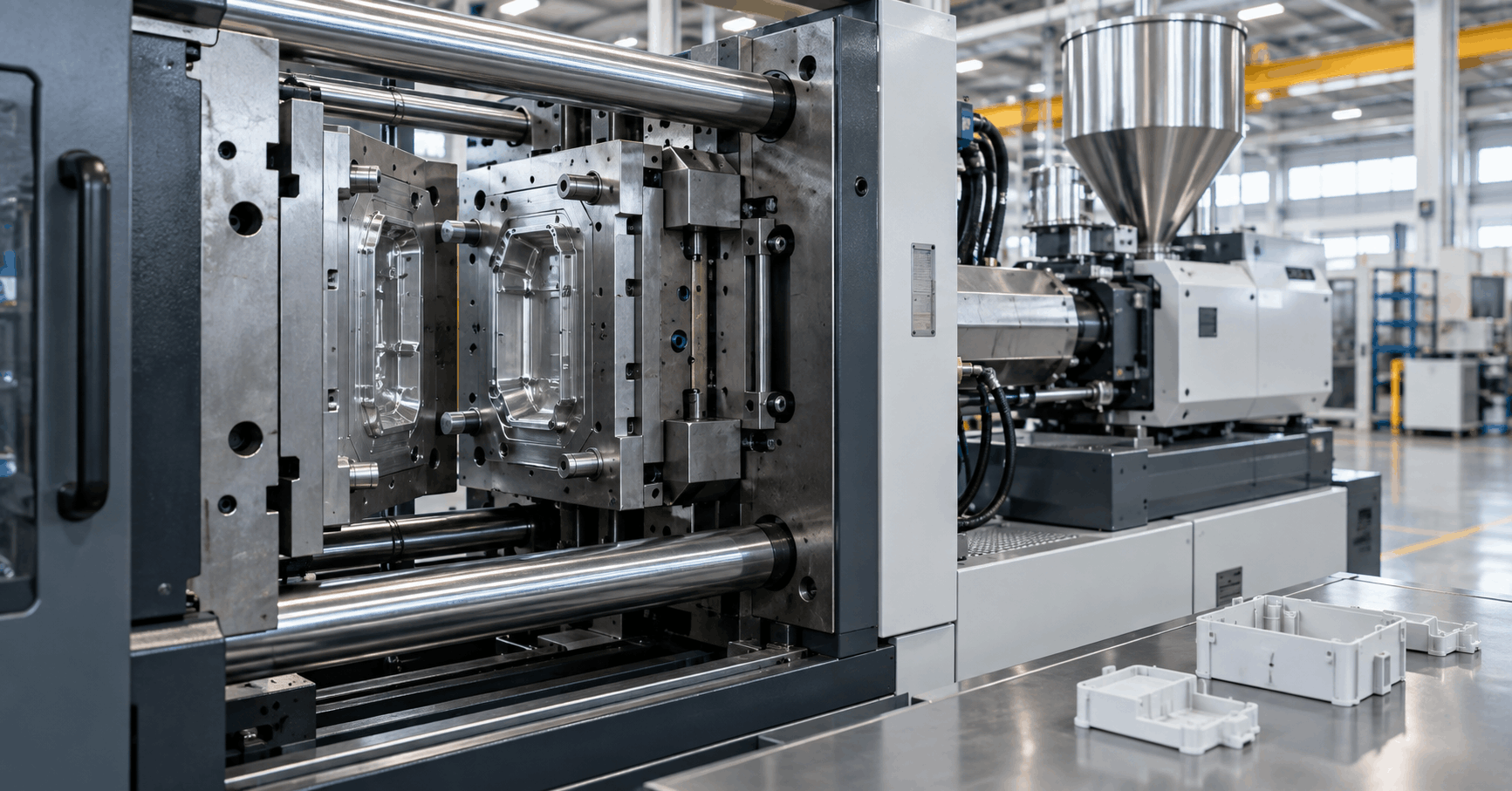
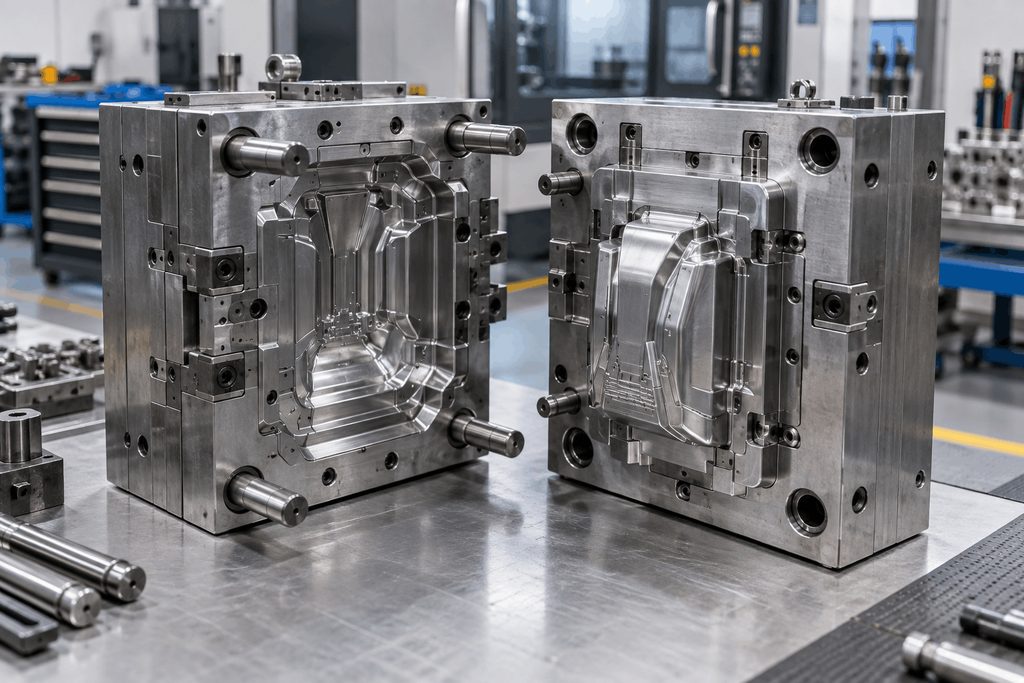
The mold is the physical production tool that creates the geometry of the finished component. Building it can require mold design, steel or aluminum preparation, CNC machining, EDM, grinding, drilling, polishing, fitting, cooling-channel work, ejection systems, assembly, sampling and modification.
The amount of engineering involved is why tooling can represent a significant upfront investment.
As of 2026, public industry guides illustrate just how broad tooling costs can be. Formlabs discusses extremely low-cost 3D-printed molds at one end and complex high-volume steel molds exceeding $100,000 at the other. Xometry similarly notes that tooling for more complex and larger programs can reach six figures. Those are broad published industry examples rather than a price schedule that applies to every supplier or project.
For a detailed look at how production tooling is developed, Haumann’s tooling engineering and mold fabrication capabilities explain the relationship between DFM, mold engineering and scalable production.
Prototype Tooling
Prototype or bridge tooling is intended for situations where the manufacturer needs molded parts before committing to a long-life production tool.
Depending on the application, the tool may use aluminum, softer steel, replaceable inserts or another lower-volume tooling strategy.
Prototype tooling may make sense when a company needs to validate:
product geometry, assembly behavior, material performance, customer testing, market demand or a limited initial production run.
The trade-off is that a lower-cost tool may not have the durability, cycle-time capability or cavity strategy required for long-term mass production.
The correct question is therefore not simply, “Which mold is cheaper?”
It is, “Which mold is appropriate for the expected life of this program?”
Production Tooling
Production tooling is designed for repeatability and an expected manufacturing life.
Depending on the program, this can require hardened tool steels, robust cooling circuits, replaceable wear components, carefully engineered gates and runners, precision ejection and more sophisticated cavity construction.
A production tool may cost more at the beginning but can make sense when the program requires stable output across a large volume of components.
That distinction matters because tool price should be evaluated against lifetime production, not only the first purchase order.
Aluminum vs. Steel Injection Molds
Aluminum can be faster and less expensive to machine and is frequently associated with prototype and lower-volume tooling.
Steel generally offers greater durability and may be preferred for demanding or long-running production programs.
Neither option is automatically “better.”
A tool should be selected according to expected volume, resin, geometry, surface requirements, mold maintenance strategy and required life.
A glass-filled engineering resin, for example, may create different wear considerations than an unfilled general-purpose thermoplastic.
Single-Cavity vs. Multi-Cavity Molds
A single-cavity mold produces one part during each molding cycle.
A two-cavity mold can potentially produce two. A four-cavity mold can potentially produce four, and so on.
Adding cavities generally increases mold size, machining, balancing requirements and upfront investment. However, when demand is high enough, producing several parts in one cycle can substantially improve production economics.
That is why the least expensive mold is not necessarily the tool that produces the lowest lifetime cost.
What Makes an Injection Mold More Expensive?
Tooling becomes more sophisticated when the component requires mechanisms or features beyond a straightforward open-and-close mold.
Slides may be needed to release side features. Lifters can help form and release certain undercuts. Inserts may be required for replaceable details or molded-in features. Complex cooling systems can improve temperature control. Hot-runner systems may reduce runner waste or support demanding cavity layouts.
Surface textures, optical finishes, large mold dimensions, tight shutoffs, complex parting lines and very tight tolerances can also increase engineering and machining requirements.
In other words, “complexity” is not an abstract surcharge. It usually represents additional mold components, machining time, design work, fitting, validation or process control.
How Much Does Injection Molding Tooling Cost in 2026?
For early budgeting, broad industry ranges can be useful—as long as they are treated as planning estimates rather than quotations.
| Tooling category | Broad planning range | Typical purpose |
|---|---|---|
| Very low-volume/printed prototype tooling | Hundreds to low thousands of dollars in some applications | Early validation and limited runs |
| Rapid or simpler machined tooling | Roughly low thousands to around $10,000+ | Prototypes, bridge production and simpler components |
| Production injection molds | Often tens of thousands of dollars | Repeat manufacturing and higher volumes |
| Large, complex or multi-cavity production tooling | Can exceed $100,000 | Complex geometry, high output or demanding production programs |
These categories intentionally overlap. Part size, tool material, cavity configuration and complexity can move a project far outside a generalized range. Formlabs’ current cost guide demonstrates a span from low-volume printed tooling to $100,000+ complex steel tooling, while Xometry gives similarly broad examples for production applications.
Protolabs, by comparison, currently states that its own injection molding service starts at approximately $1,495 depending on geometry and complexity. That should be interpreted as a provider-specific starting point, not an industry-wide minimum.
For additional budgeting context, see Formlabs’ injection molding cost guide and Xometry’s injection molding cost breakdown.
Injection Molding Material Cost
After tooling, raw material is one of the most important recurring costs.
Common thermoplastics include polypropylene (PP), ABS, polycarbonate (PC), polyethylene (PE), nylon/PA, TPE/TPU and many specialized engineering polymers.
The cheapest resin is not necessarily the least expensive material for the application.
A component exposed to heat, chemicals, outdoor weather, mechanical loads or dimensional stability requirements may need a higher-performance grade. Filled and reinforced materials can also influence mold wear and processing conditions.
A useful simplified calculation is:
Material Cost Per Part = Effective Material Usage × Effective Resin Cost
“Effective material usage” may include more than the net finished-part weight. Depending on the mold and process, runners, sprues, purge, scrap and allowable regrind strategy can affect consumption.
Imagine a part that weighs 80 grams. Two materials may appear similar on a resin-price spreadsheet, but differences in density, processing window, cycle behavior or reject rate can change the actual production economics.
Material should therefore be selected based on functional requirements first, followed by cost optimization within those requirements.
Does Recycled or Reprocessed Material Reduce Injection Molding Cost?
Sometimes—but it should not be assumed.
Recycled material or controlled regrind can potentially reduce virgin resin consumption in applications where it is technically and contractually acceptable. But the decision depends on material properties, appearance, regulatory requirements, traceability, mechanical performance and customer specifications.
For demanding components, the cost of inconsistent performance may be far greater than the resin savings.
Material strategy should therefore be evaluated as an engineering decision, not just a purchasing decision.
How Production Volume Changes Injection Molding Cost Per Part
Production volume is one of the biggest reasons injection molding can become economically attractive.
Tooling is largely a fixed upfront expense.
Production costs such as material, machine time and labor occur as parts are manufactured.
When the same tool is used for a larger production quantity, the tooling investment can be distributed across more finished parts.
The basic concept is:
Effective Cost Per Part = Tooling Cost ÷ Production Quantity + Manufacturing Cost Per Part
Consider a hypothetical example.
Suppose tooling costs $20,000 and recurring manufacturing cost is $0.80 per part.
At 10,000 parts:
$20,000 ÷ 10,000 + $0.80 = $2.80 effective cost per part
At 100,000 parts:
$20,000 ÷ 100,000 + $0.80 = $1.00 effective cost per part
At 500,000 parts:
$20,000 ÷ 500,000 + $0.80 = $0.84 effective cost per part
These figures are intentionally simplified and hypothetical. They do not include every commercial factor and are not a Haumann quotation.
But the calculation demonstrates an important principle: the same $20,000 mold looks very different when evaluated against 10,000 parts versus 500,000 parts.
This is why procurement teams should compare suppliers using expected program volume rather than only the first order.
Protolabs also describes this amortization effect in its guide to reducing injection molding costs.
How Mold Cavities Affect Injection Molding Pricing
Cavity count can change both the tooling investment and the unit economics.
| Mold configuration | Upfront tooling | Parts produced per cycle | Typical economic consideration |
|---|---|---|---|
| 1 cavity | Lower relative complexity | 1 | Useful when demand or tooling budget does not justify multiple cavities |
| 2 cavities | Higher | 2 | Can increase output without doubling cycle time |
| 4 cavities | Higher still | 4 | Often considered for larger repeat volumes |
| 8+ cavities | Significantly more complex | 8+ | May offer strong volume economics when demand justifies the tooling |
More cavities do not automatically guarantee lower cost.
The mold must fill and cool effectively. Runner design, gate balance, machine capacity, part quality and cavity-to-cavity consistency all matter.
For example, an eight-cavity mold that produces inconsistent parts or requires a machine that is poorly matched to the tool can create problems that outweigh the theoretical production advantage.
Cavity count should therefore be selected using forecast volume, machine capacity, tooling budget and expected program life.
Machine Size and Cycle Time: Two Hidden Drivers of Piece Price
Two parts made from the same resin can have very different production costs because they require different machines or cycle times.
Machine Size
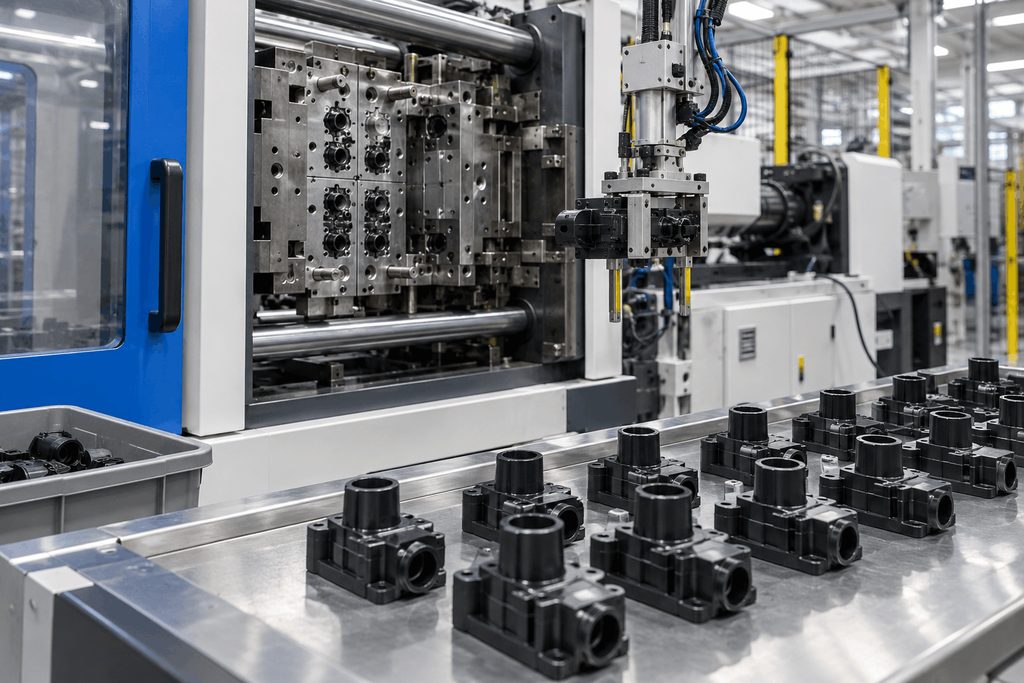
Injection molding machines are commonly selected based on requirements such as clamping force, shot capacity and mold dimensions.
A larger component may require more clamp tonnage to keep the mold closed during injection. A larger shot may require greater injection capacity. A large mold also needs enough platen and tie-bar space.
As machine requirements increase, hourly production economics can change.
This is one reason reducing unnecessary part size or projected area can sometimes influence manufacturing cost.
Cycle Time
Cycle time is the period required to complete one molding cycle.
It includes filling, packing, cooling, mold opening, ejection and closing.
Cooling frequently represents a substantial portion of the cycle.
Imagine two identical-looking components. One molds reliably every 20 seconds, while another requires 45 seconds because of heavy wall sections or difficult cooling.
Even if material usage is similar, the second component consumes considerably more machine time for the same production quantity.
That makes cycle-time optimization an important part of DFM and tool design.
Efficient cooling, appropriate wall thickness and stable processing can influence the economics of a high-volume program for years.
Labor, Quality Control and Secondary Operations
The molded component may only be one stage of the finished product.
A quoted “piece price” can become misleading when additional operations are required after molding.
Insert installation, manual assembly, overmolding, trimming, pad printing, laser marking, painting, coating, ultrasonic welding, heat staking, inspection, labeling, packaging and kitting can all contribute to the cost of a finished component.
Suppose Supplier A offers a molded piece at $0.90 while Supplier B quotes $1.05.
Supplier A may appear cheaper until the buyer discovers that assembly, inspection and packaging must be handled by separate vendors.
Supplier B might include more of the completed manufacturing scope.
The more useful comparison is therefore:
finished-part cost at the required quality level, not simply molded-part price.
Haumann’s high-volume plastic manufacturing and integrated assembly capabilities are relevant for OEM programs where molding is only one part of the manufacturing workflow.
Shipping, Logistics and Total Landed Cost
Factory price is not the same as total cost.
A manufacturing program can also include freight, insurance, duties or tariffs where applicable, customs administration, packaging, warehousing, inventory carrying cost, quality oversight and the financial impact of long transit times.
A useful conceptual formula is:
Total Landed Cost = Tooling + Manufacturing + Freight + Applicable Duties/Taxes + Warehousing + Inventory + Quality/Rework Costs
This is especially important when buyers compare domestic manufacturing with international sourcing.
A cheaper factory piece price can remain cheaper after logistics are included—or it may not.
The answer depends on the actual program.
There is no universal rule that U.S. production is always more economical or that Asian production is always less expensive.
For the buyer, the objective should be to compare the complete supply model.
Injection Molding Cost in Texas and the USA
For companies sourcing in Texas, cost discussions often include more than mold price and unit price.
Communication with engineering teams, freight distance, production responsiveness, tooling coordination, quality control and supply-chain strategy can influence the commercial decision.
A Texas OEM, for example, may value access to local engineering support during DFM, validation or production troubleshooting. Another program may benefit from combining U.S.-based project support with global manufacturing capacity.
Haumann provides plastic injection molding in Houston, Texas, with Houston-based engineering and production support for OEM programs.
For buyers specifically researching regional pricing considerations, the company’s guide to injection molding cost in Texas examines tooling, production and total landed-cost factors in greater detail.
The important point is that “injection molding cost Texas” should not be reduced to a single regional price.
A manufacturer still needs to evaluate the individual part, material, annual volume, tooling strategy and finished-product requirements.
USA vs. Asia Injection Molding Cost
It is tempting to compare sourcing regions using only two columns of mold prices and piece prices.
Real manufacturing decisions are more complicated.
| Factor | USA manufacturing | Asia manufacturing |
|---|---|---|
| Tooling investment | Project dependent | Project dependent |
| Part price | Depends on resin, labor, scale and manufacturing strategy | Depends on resin, labor, scale and manufacturing strategy |
| Engineering communication | Closer time zones may simplify collaboration for U.S. companies | Coordination across time zones may be required |
| Domestic freight | Can reduce international transport for U.S. delivery | International freight normally applies for U.S. delivery |
| Import considerations | Typically simpler for domestic movement | Customs, duties or tariffs may apply depending on origin and classification |
| Production scale | Supplier dependent | Supplier dependent |
| Quality | Supplier and quality system dependent | Supplier and quality system dependent |
| Lead-time exposure | Primarily domestic logistics for U.S.-made parts | Production plus international transportation must be considered |
| Inventory strategy | May support shorter replenishment loops in some programs | Longer transit can require different inventory planning |
Neither manufacturing region should automatically be classified as “better.”
For one project, domestic production may provide the right economics and responsiveness.
For another, global production may provide a stronger tooling or high-volume manufacturing strategy.
For a third, a blended or dual-location model may make sense.
The correct comparison is:
tooling + lifetime piece cost + logistics + inventory + quality + lead time + supply-chain requirements.
8 Ways to Reduce Injection Molding Cost
Reducing injection molding cost does not necessarily mean choosing cheaper materials or negotiating a lower mold price. The most effective savings often come from making the entire manufacturing system simpler and more efficient.
1. Simplify Unnecessary Part Geometry
Every molded feature should have a functional reason.
Complex recesses, side holes, reverse features and unnecessary cosmetic geometry can increase tool construction requirements.
If a non-critical feature requires a slide or lifter but could be redesigned for straight-pull molding, the tooling strategy may become simpler.
2. Reduce Avoidable Undercuts
Undercuts frequently require side actions, lifters, collapsible mechanisms or redesign of the parting strategy.
Sometimes those features are essential.
Sometimes they can be eliminated through relatively small changes before tooling begins.
This is one reason an early DFM review can have substantial value.
3. Optimize Wall Thickness
Very thick sections increase material consumption and can extend cooling time.
Highly inconsistent walls can also contribute to molding challenges such as sink, warpage or differential shrinkage.
The goal is not to make every component thin.
It is to design wall sections appropriate for the chosen resin and mechanical requirements.
4. Specify Tolerances Based on Function
Tight tolerances should be placed where the product actually needs them.
Applying extremely tight dimensional requirements to every feature can increase toolmaking, process control and inspection requirements without improving product performance.
Engineers should distinguish between critical dimensions and dimensions that can tolerate broader variation.
5. Select Material Based on Actual Performance Requirements
Using a premium engineering polymer for a component that performs adequately in a less expensive material can add recurring cost to every production run.
The opposite mistake is equally costly: choosing a cheaper resin that creates failures, returns or production problems.
Material optimization means meeting requirements without unnecessary over-specification.
6. Match Cavity Count to Forecast Volume
More cavities can improve production output, but they also require additional tooling investment.
A lower-volume program may not recover that investment.
A long-running program may benefit considerably.
Cavity decisions should therefore be based on realistic forecasts rather than an assumption that “more cavities are always better.”
7. Perform DFM Before Cutting Steel
One of the least expensive times to change a product is while it is still a CAD model.
After the mold has been manufactured, even a seemingly small design change may require welding, machining, new inserts or more significant tool modifications.
DFM should review draft, wall thickness, undercuts, gate strategy, ejection, parting lines, ribs, bosses, tolerances and material behavior before tooling is released.
Haumann discusses these considerations in its custom plastic injection molding cost guide.
8. Optimize Total Cost, Not Just the Mold Quote
A $15,000 mold is not automatically a better purchase than a $25,000 mold.
If the more expensive tool supports shorter cycles, more cavities, less scrap or longer service life, it could produce the lower lifetime cost.
Likewise, the lowest quoted piece price may not remain the lowest after freight, inventory, quality issues and secondary operations are included.
Engineering and procurement teams should compare the economics across the anticipated life of the program.
Injection Molding Cost Example: Why Lifetime Volume Matters
Consider two hypothetical suppliers quoting a program expected to produce 250,000 parts.
| Supplier A | Supplier B | |
|---|---|---|
| Tooling | $22,000 | $35,000 |
| Piece price | $1.05 | $0.92 |
| Expected lifetime volume | 250,000 | 250,000 |
| Lifetime production spend | $262,500 | $230,000 |
| Tooling + production | $284,500 | $265,000 |
Supplier A has the less expensive mold.
Supplier B has the lower modeled lifetime cost.
This simplified example excludes freight, inventory, maintenance and other commercial variables, but it demonstrates why buyers should avoid evaluating tooling and piece price separately.
The appropriate supplier is not automatically the one with the lowest mold quote or the lowest initial purchase order.
It is the supplier whose manufacturing strategy fits the requirements of the complete program.
What Information Is Needed for an Accurate Injection Molding Quote?
The quality of an injection molding quote depends heavily on the quality of the information supplied to the manufacturer.
| Information | Why the manufacturer needs it |
|---|---|
| 3D CAD file | Defines the geometry used for moldability and tooling review |
| 2D drawing | Communicates dimensions, tolerances, notes and critical features |
| Material/resin | Influences shrinkage, tooling, processing and part performance |
| Color | Can affect resin preparation and production requirements |
| Surface finish | Influences mold finishing and cosmetic expectations |
| Tolerance requirements | Identifies precision and inspection needs |
| Initial order quantity | Helps plan the first production run |
| Annual volume | Influences cavity count and tooling strategy |
| Expected program life | Helps determine appropriate tool construction |
| Prototype requirements | Identifies validation needs before production |
| Secondary operations | Captures assembly, welding, printing, inserts and other steps |
| Inspection requirements | Defines dimensional, cosmetic and quality expectations |
| Packaging | Determines finished-product handling requirements |
| Delivery destination | Helps evaluate freight and logistics |
| Target production date | Supports tooling and launch planning |
Submitting only a screenshot or basic part dimensions usually forces the supplier to make assumptions.
Those assumptions can later result in quote revisions.
A complete RFQ package allows the manufacturer to provide a much more meaningful assessment.
How to Compare Injection Molding Quotes Correctly
When two quotations differ substantially, do not immediately assume one supplier is overpriced.
First verify whether the suppliers are quoting the same scope.
Are both molds using comparable tool steel? Are cavities the same? Is expected mold life similar? Does one quotation include a hot runner while the other uses a cold runner? Are inspection requirements equal? Is resin included? Is packaging included? Who owns the tool? Where will the tool run? Are maintenance expectations defined? Are secondary operations included?
These questions often reveal why apparently similar quotations are not actually comparable.
For OEM buyers evaluating manufacturers, Haumann’s guide on how to choose a reliable custom plastic injection molding supplier provides additional supplier-selection considerations.
Another useful external reference is Protolabs’ current injection molding pricing information, which demonstrates how geometry, complexity and manufacturing model influence supplier pricing.
When Does Injection Molding Make Financial Sense?
Injection molding is usually strongest when the economics justify investing in tooling to achieve repeatable production.
For very small quantities, CNC machining, urethane casting or additive manufacturing may sometimes be more practical because they avoid substantial hard-tool investment.
As required volume increases, injection molding becomes increasingly attractive because a properly designed process can repeatedly produce parts while distributing tooling cost over a larger quantity.
There is no universal break-even quantity.
A small, simple molded part may justify tooling at a considerably lower volume than a very large, complex component requiring an expensive multi-action mold.
The correct break-even calculation should compare:
Tooling Investment + Injection Molding Unit Cost
against
Alternative Manufacturing Cost × Required Quantity
and then consider quality, material performance, production capacity and future demand.
How Much Does Injection Molding Cost Per Part?
There is no reliable universal price-per-part range.
Some small, uncomplicated high-volume parts may cost well under one dollar to manufacture. Larger, heavier or more complex parts can cost several dollars, tens of dollars or more.
Published examples illustrate that variation rather than establishing a market rate. Protolabs, for instance, provides example piece prices from under $1 to several dollars depending on part complexity and tooling configuration; its page explicitly presents them as illustrative examples.
That is why a statement such as “injection molding costs $1 per part” is not meaningful without information about:
part weight, resin, cycle time, machine requirement, cavities, annual volume, labor, finishing and inspection.
For purchasing teams, piece price should always be evaluated together with tooling and projected lifetime quantity.
Frequently Asked Questions About Injection Molding Cost
Injection molding cost depends on the upfront mold investment and the recurring production cost of each part. Tooling can range from relatively inexpensive prototype approaches to production molds costing tens of thousands of dollars or more. Resin, geometry, part size, cavities, tolerances, volume, cycle time and secondary operations all influence the final quotation.
There is no fixed injection mold price. A simple prototype or bridge tool may cost a few thousand dollars, while complex production tooling can cost tens of thousands or exceed $100,000. Published industry guides demonstrate this broad range, but the actual price requires review of the part design and expected production requirements.
A mold is a precision production system rather than simply a cavity cut into metal. It may require CNC machining, EDM, cooling circuits, gates, runners, ejectors, slides, lifters, inserts, polishing, fitting, assembly, sampling and dimensional validation. Complex geometry and long production-life requirements increase the engineering and manufacturing work needed to build the tool.
Part price depends on resin consumption, machine time, cycle time, cavities, labor, scrap, inspection and secondary operations. Tooling can also be allocated across the production volume when calculating an effective lifetime cost per part. Because those variables differ considerably between projects, an accurate piece price requires a project-specific quotation.
The effective cost per part often decreases as production quantity increases because fixed tooling costs are spread across more parts. Higher volumes may also justify multi-cavity tooling or automation. However, the actual savings depend on mold design, cycle time, material, machine utilization and other production requirements.
There is no universal quantity. The break-even point depends on tooling cost, molded-part cost and the cost of alternative processes such as CNC machining or additive manufacturing. A simple component may justify tooling relatively early, while a complex and expensive mold may require substantially more lifetime volume.
It can. A multi-cavity tool produces multiple parts during one cycle, which can increase output and reduce machine-time allocation per component. However, additional cavities increase tooling cost and complexity. Multi-cavity tooling therefore makes the most financial sense when production volume is sufficient to recover the additional investment.
Start with DFM before tooling is built. Simplifying unnecessary geometry, reducing avoidable undercuts, optimizing wall thickness, specifying realistic tolerances, choosing the right resin and matching cavity count to expected production volume can all improve project economics. Total landed cost should also be evaluated instead of comparing tool price alone.
A manufacturer will usually need a 3D CAD model, material requirement, expected quantity or annual volume, tolerances, surface finish, color, secondary operations, quality requirements and delivery location. A 2D drawing is particularly useful when critical tolerances or manufacturing notes must be clearly communicated.
Neither region is automatically cheaper for every project. Tooling, labor, production scale, freight, duties, inventory, lead times, engineering support and quality requirements all influence the total cost. Buyers should compare total landed cost and lifetime program economics rather than factory piece price alone.
The Bottom Line on Injection Molding Cost in 2026
Injection molding cost is not one number.
It is the result of a connected manufacturing system that begins with part design and continues through tooling, resin selection, molding, quality control, secondary operations and logistics.
For engineers, the best opportunity to control cost often occurs before the mold is built.
For procurement teams, the most important lesson is to compare total program cost rather than tooling price alone.
For startups and product developers, understanding annual volume can help determine whether production tooling is justified and what kind of mold makes sense.
And for established industrial companies, optimizing cavities, cycle time, material, automation and supply strategy can create savings that continue across hundreds of thousands—or potentially millions—of parts.
The most accurate injection molding pricing therefore starts with real project data.
Need a Project-Specific Injection Molding Cost Estimate?
If you already have a 3D CAD model, drawing, material specification or estimated annual production volume, Haumann Technology can review those requirements and help determine an appropriate tooling and manufacturing strategy.
Send your design details through Haumann’s injection molding quote and DFM review page to discuss tooling, production requirements and project-specific pricing.