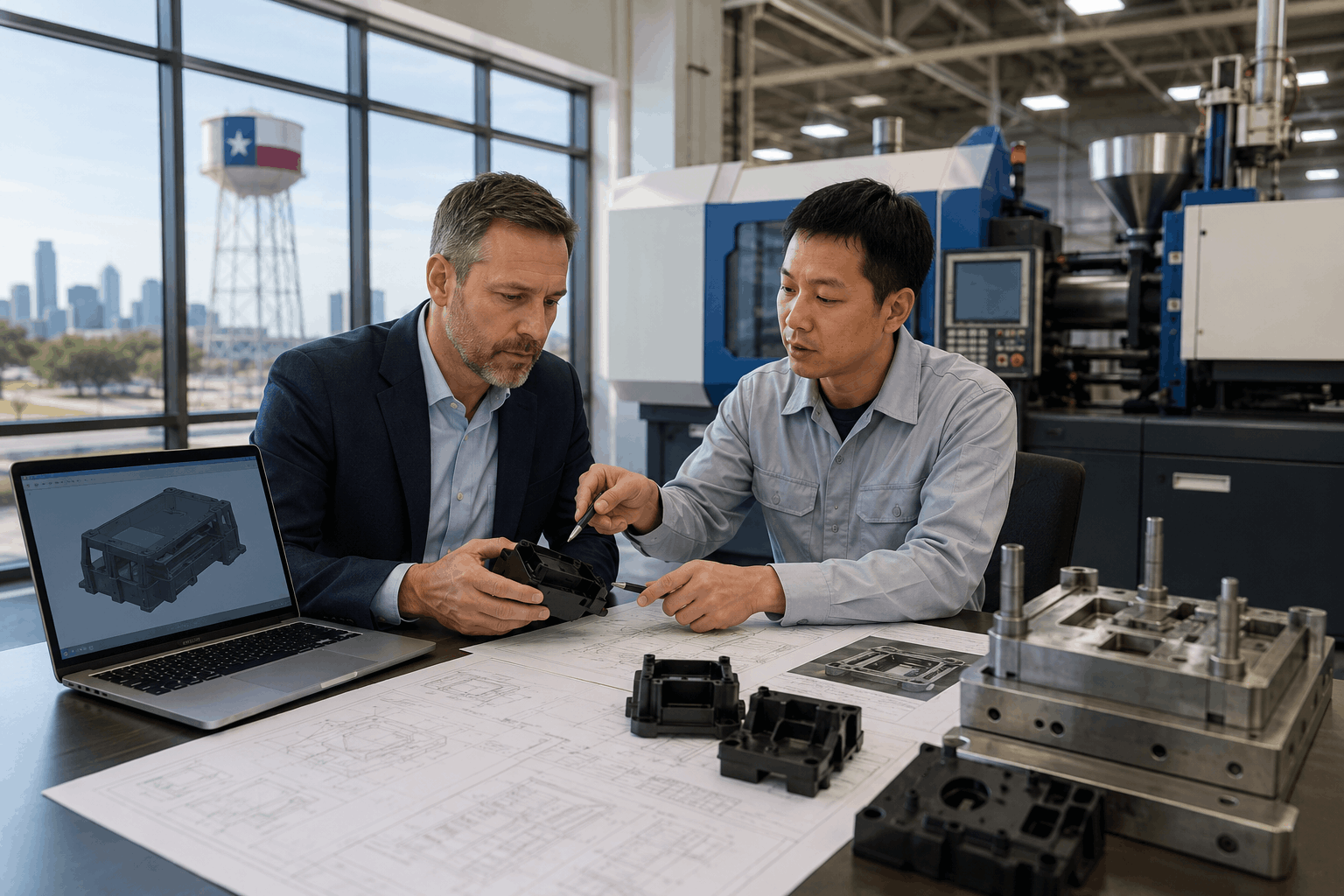
Traceability in automotive manufacturing is not simply a recordkeeping task. It is the ability to identify a specific part, connect it to the conditions under which it was produced, and define the smallest credible population of related parts when a quality issue appears.
This discipline becomes especially important in high-volume injection molding, where a small process shift can affect a large production population.
That capability matters long after a component leaves the molding plant. A warranty return may arrive months or years later with a defect that was never visible during routine inspection. The investigation may require the production date, material batch, molding machine, tool cavity, process data, inspection status, and secondary operations completed before shipment.
A well-designed VDA traceability injection molding system creates that connection. A machine-readable identifier on the part links the physical component to a controlled digital production history. Instead of treating every similar part as suspect, the manufacturer can use evidence to narrow the investigation to units that share relevant production conditions.
This article explains how VDA-aligned automotive part traceability works, what information may be captured for each molded component, how DataMatrix part marking supports serialization, and why traceability is essential for containment, audits, and quality improvement.
Why Automotive Traceability Matters
Automotive supply chains are complex. One vehicle may contain components produced by multiple tiers of suppliers, transported across regions, assembled into modules, and integrated into the final vehicle elsewhere. When a field issue is reported, the failed component may appear identical to thousands of parts that continue to perform correctly.
Without reliable traceability, the supplier may know the part number but not the exact production event. It may be difficult to determine which material lot was used, which cavity produced the component, or whether the part passed through a specific downstream operation.
That uncertainty expands containment. When the affected population cannot be defined confidently, quality teams may have to hold or inspect a much larger quantity of material across multiple shifts, shipments, or production lots.
Traceability changes the response from assumption to evidence. A unique serial number or controlled lot identifier connects the returned component to its production history. The team can compare the failed unit with parts made on the same machine, from the same material lot, within the same process window, or through the same secondary operation.
The goal is not to guarantee that every recall will be small. The goal is to establish a defensible boundary around the potentially affected population. Accurate boundaries support faster containment, focused testing, clearer customer communication, and a more efficient root-cause investigation.
Where VDA, IATF 16949, and Customer Requirements Fit
The VDA 6.3 process-audit framework is used to evaluate whether development and manufacturing processes are capable, controlled, and consistently implemented. Traceability supports that objective because auditors need evidence that material, process, inspection, and product records can be connected.Automotive traceability is not controlled by one document. The quality-management system, customer-specific requirements, product risk, regulatory obligations, drawings, and the approved control plan shape it.
VDA 6.3 provides a process-audit framework used to evaluate whether development and manufacturing processes are capable, controlled, and consistently implemented. Traceability supports that objective because auditors need evidence that material, process, inspection, and product records can be connected.
VDA 6.5 addresses product audits. A product audit verifies whether finished parts meet defined customer requirements. Reliable identification connects the audited sample to its production records and supports follow-up when a deviation is found.
VDA 260 is relevant to material identification on automotive components. For molded polymer parts, markings such as >PA66-GF30< communicate the material family and reinforcement. This marking is different from a serialized DataMatrix code. The material code identifies what the part is made from; the traceability code identifies the individual part or production lot and links it to manufacturing data.
IATF 16949 and customer-specific requirements add expectations for identification, traceability, production history, evidence of conformity, and control of suspect product. The exact implementation varies by OEM and component risk. A safety-related battery component may require more detailed serialization and retention than a low-risk component.
“VDA-aligned” traceability is therefore not a universal template. The system must be designed around the customer specification, approved quality documents, product characteristics, and required level of containment.
The Role of DataMatrix Part Marking
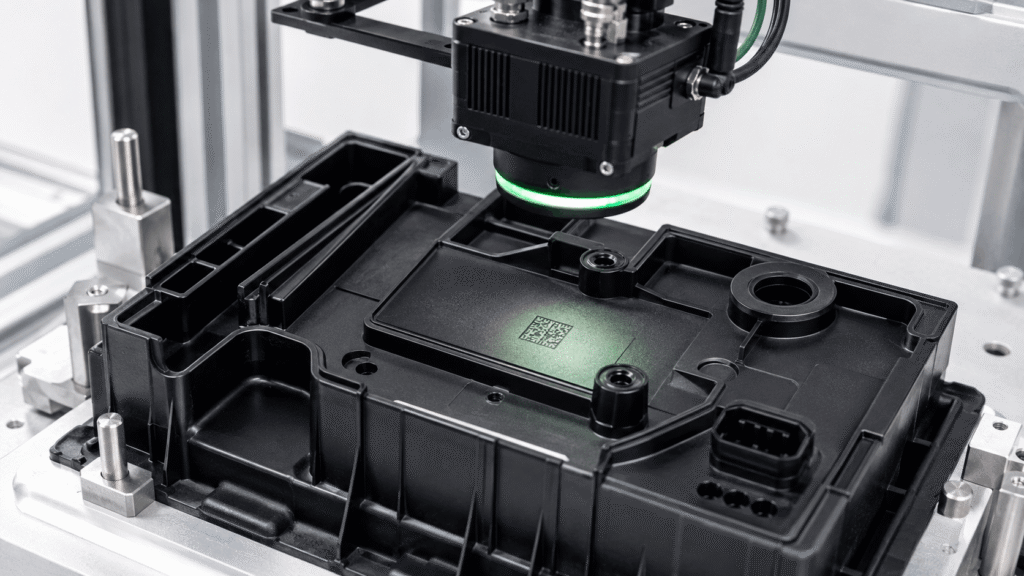
The visible entry point to many automotive traceability systems is a DataMatrix code. DataMatrix is a compact two-dimensional symbol that can store structured identification data in a small area. It is well suited to industrial applications where marking space is limited and automated scanning is required.
A DataMatrix symbol can be applied by laser marking, label printing, inkjet marking, or another validated method. The correct process depends on the material, surface texture, contrast, environmental exposure, cycle time, and customer specification.
For a molded automotive component, encoded data may include:
- Customer part number
- Supplier identifier
- Production date or date code
- Lot or batch identifier
- Unique serial number
- Manufacturing location or line identifier
The code should contain only the information required by the approved specification. More encoded data is not automatically better. The symbol must remain readable at the selected size, with sufficient contrast and a clear quiet zone.
ECC 200 error correction helps a DataMatrix symbol remain readable when portions of the mark are degraded. However, error correction is not a substitute for marking quality. The symbol still needs to meet program requirements for size, contrast, cell geometry, location, verification grade, and durability.
Code Verification and Readability Controls
A traceability mark should be verified during production, not only checked visually. Verification can confirm symbol contrast, cell shape, quiet-zone condition, orientation, and overall readability against the approved marking specification. The control plan should define how often verification is performed, what grade or acceptance level is required, and what happens when a code fails. Unreadable or duplicated identifiers must be contained immediately because they break the link between the physical part and its digital history. Verification records should also remain associated with the relevant production batch securely.
DataMatrix and Material Identification Are Different
A molded component may carry both a traceability code and a material identification mark, but they serve different purposes.
The material mark, such as >PA66-GF30<, identifies the polymer and reinforcement. It supports material recognition, recycling considerations, drawing compliance, and technical communication.
The DataMatrix or serial identifier connects the component to a digital record. Scanning the code may return the production date, material batch, machine, cavity, inspection status, and downstream process history.
A visible part number alone does not provide full traceability. A part number identifies the design, not the individual production history. Millions of components can share the same part number. Serialization or controlled lot identification separates one production event from another.
How Date Codes Should Be Managed
Date codes identify when a part was produced, but there is no single format for every automotive program. The coding method should come from the customer specification, drawing, packaging standard, or approved manufacturing documentation.
Some programs use a full date. Others use a compact combination of letters and numbers to reduce the number of DataMatrix cells. A scheme may assign one character to the year and another to the day while excluding characters that could be confused with numbers.
The exact mapping must be controlled in a specification and reference table available to production, quality, and customer-support teams. The requirement is unambiguous decoding throughout the retention period.
The coding system should define:
- Character mapping and excluded characters
- Cycle or rollover rules
- Day-of-month or day-of-year basis
- Shift or production-window identification
- Rules for rework and re-marking
- Verification requirements
A program-specific coding table is a controlled quality document. Changes should be reviewed before implementation so new codes do not conflict with historical records.
What Data Is Captured for Each Molded Part?
Automotive components often move through secondary operations after molding. Heat staking for plastic features, resistance butt welding, metal insertion, labeling, leak testing, electrical testing, and final assembly may create additional traceability records.
Material Lot and Preparation History
The record can identify the resin manufacturer, material grade, incoming lot, certificate status, and internal batch. For hygroscopic materials, it may include drying equipment, time, temperature, or moisture-control status where required.
Material-lot traceability helps identify which parts used affected resin and which parts can be excluded from containment.
Injection Molding Machine, Tool, and Cavity
The record may identify the molding press, mold number, tool revision, cavity, and cycle count. Cavity-level identification is useful for multi-cavity molds because a dimensional or cosmetic issue may affect only one cavity.
Process Parameters and Cycle Data
Depending on the monitoring strategy, the system may store recipe identification, melt temperature, mold temperature, injection pressure, hold pressure, fill time, cooling time, cycle time, and selected process signatures.
Not every machine value needs to be stored for every component. Retained data should reflect the characteristics that matter to quality and the requirements established during validation.
Operator, Shift, and Production Window
The production record may include the operator, shift, cell, and timestamp. These fields provide context when combined with maintenance records, material changes, alarms, or setup activity.
Inspection and Test Results
Dimensional inspection, visual checks, functional tests, automated vision results, and statistical process-control records may be associated with the serial number or production lot.
The record should distinguish accepted, rejected, reworked, and quarantined product to prevent suspect material from being mixed with conforming production.
Downstream Assembly Operations
Automotive components often move through secondary operations after molding. Heat staking, resistance butt welding, metal insertion, labeling, leak testing, electrical testing, and final assembly may create additional records.
When possible, downstream data should remain connected to the original molded-part identifier, creating a continuous genealogy from raw material through assembly to the shipped component.
From Production Event to Digital Part History
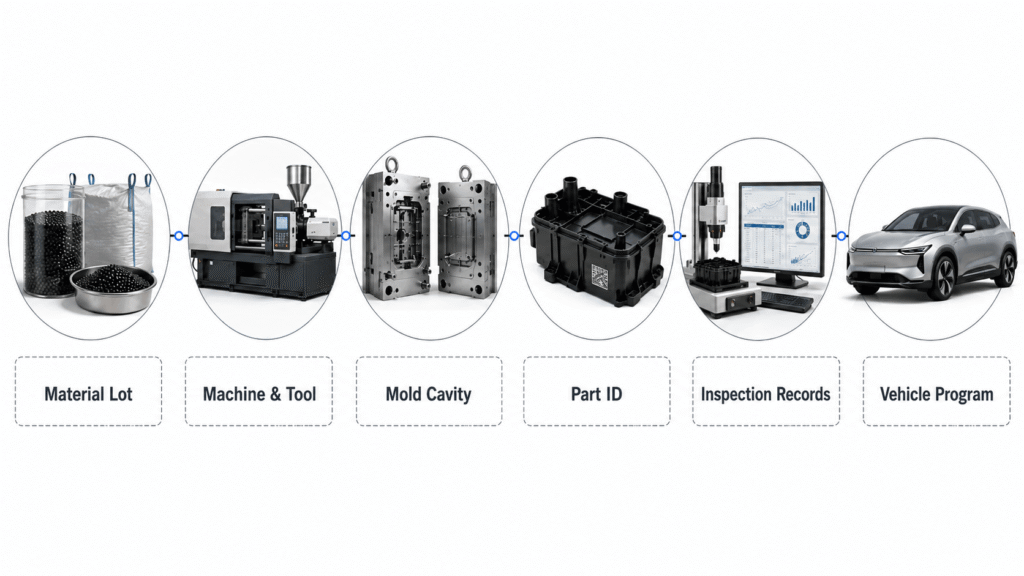
A practical traceability system connects equipment, identification, and business records. The architecture may include a manufacturing execution system, machine-data collection, quality software, an ERP platform, or a controlled internal database.
When a part is produced, the molding machine and related systems create a production event linked to the approved recipe, material lot, mold, cavity, time, and inspection status.
When the DataMatrix code is marked and verified, the serial number is associated with that event. Secondary operations add records to the same genealogy. At shipment, serials or controlled lots can be associated with the customer order, container, pallet, and shipping documentation.
A successful system must make data retrievable. During an audit or investigation, authorized personnel should be able to scan a code or enter a serial number and access the relevant history without searching unrelated spreadsheets.
Access controls, backups, record-change management, time synchronization, and cybersecurity also protect the integrity of the production history.
Retention Must Match the Program
Customer requirements, legal obligations, internal quality procedures, and product design life should define record retention. A universal period should not be assumed for every automotive component.
The retention plan should identify:
- Records that must be retained
- Required retention period
- Responsible system owner
- Backup and recovery requirements
- Access permissions
- Historical retrieval procedures
- Secure disposal rules
A traceability system is useful only while its records remain accessible and understandable. Keeping a serial number without the database that explains it does not provide meaningful traceability.
Recall Containment: Where Traceability Proves Its Value
The strongest test of automotive part traceability occurs when a customer reports a suspected field or production defect.
The affected code is scanned, and the production history is retrieved. Quality teams review the material lot, machine, cavity, process window, inspection results, and downstream operations. They then search for components that share the conditions most likely related to the failure.
This analysis creates a defined suspect population. The scope may include a single cavity, material batch, time window, downstream station, or combination of variables.
The result is targeted recall containment based on evidence. The organization can explain why certain parts are included and why others are excluded. That justification is important when communicating with an OEM, Tier 1 customer, or regulatory authority.
Traceability does not replace failure analysis. It makes failure analysis actionable by identifying where to look and which parts require attention.
Warranty Analytics: Turning Field Data Into Prevention
Traceability also supports prevention. When returned parts are scanned and connected to production records, warranty data can be compared with manufacturing history.
Several returns may reveal a cluster around one material lot, mold cavity, maintenance interval, or process trend. That correlation can direct engineers toward a root cause faster than visual inspection alone.
Corrective actions may include updating process limits, revising material controls, adjusting preventive maintenance, improving code verification, changing inspection frequency, or adding an automated reaction plan.
This is where molded part serialization moves beyond compliance. The traceability record becomes manufacturing intelligence that helps prevent future defects.
Frequently Asked Questions
VDA-aligned traceability is the controlled identification of molded automotive parts and the linkage of those identifiers to production, material, inspection, and downstream process records. Requirements are defined by the customer program, quality system, product risk, and control plan.
VDA 260 is primarily associated with material identification on automotive components. A material code such as >PA66-GF30< is not the same as a serialized DataMatrix. DataMatrix requirements normally come from the customer drawing, identification specification, or program documentation.
Fields may include a part number, supplier identifier, production date, lot code, and serial number. Some information can remain in the backend database rather than being encoded directly. The customer specification determines the final structure.
DataMatrix stores structured data in a compact symbol and is widely used for industrial identification and direct part marking. Selection should still follow customer requirements, marking space, scanning equipment, durability, and verification criteria.
ECC 200 error correction can help recover information when part of the symbol is damaged. Actual readability depends on the damage, marking quality, scanner capability, and verification grade. Production should rely on validated marking, not error correction alone.
Traceability identifies the production conditions linked to an affected part and finds other parts with matching conditions. This supports an evidence-based containment scope instead of treating every part with the same part number as suspect.
The molded part’s serial number or lot identifier can remain associated with heat staking, metal insertion, busbar welding, inspection, and final assembly. Each stage adds records to the same part genealogy.
Retention periods vary by customer, component, jurisdiction, contract, and product risk. The approved quality plan should define which records are retained, for how long, and how they remain retrievable.
Legal and regulatory obligations vary by market and product. Suppliers must also meet customer-specific requirements, quality-system requirements, and applicable recall obligations for each program and destination market.
Build Traceability Into the Manufacturing Process
Traceability works best when designed into the component, tooling, marking process, data architecture, and control plan from the beginning. Adding identification after production starts can create unreadable codes, missing data links, and gaps between molding and downstream assembly.
Haumann Group supports precision injection molded automotive components and integrated assemblies with program-specific identification, process control, and production traceability.
Contact our engineering team to discuss DataMatrix part marking, molded part serialization, material-lot tracking, downstream process records, and scalable traceability for your automotive program.