Heat Staking vs Ultrasonic Welding: How to Choose the Right Plastic Joining Process
Both heat staking and ultrasonic welding solve the same problem: joining a plastic component to another part — often metal, a PCB, or a second plastic part — without screws, rivets, or adhesives. They are not interchangeable. The wrong choice shows up later as cracked bosses, joints that loosen under vibration, damaged electronics, or a process that cannot hold consistency at production volume.
The short answer: choose heat staking when the material is glass-filled or semi-crystalline, when the plastic must be joined to metal or other dissimilar materials, when components near the joint are sensitive to vibration, or when many joints must be formed in one cycle. Choose ultrasonic welding when two compatible thermoplastics must be fused into one sealed part, when cycle time is the dominant pressure, and when the assembly contains nothing that vibration can harm. The rest of this article explains why — factor by factor — so the decision can be made on engineering grounds rather than habit.
Key Takeaways
- Heat staking forms a mechanical lock: a heated tool reshapes a plastic boss over the mating part. Best for glass-filled plastics, plastic-to-metal joints, and assemblies containing electronics.
- Ultrasonic welding creates a material fusion: 20–40 kHz vibration melts the joint interface. Best for sealing two compatible thermoplastics together, fast.
- Material — especially glass fibre content — decides the question more often than cost or speed do.
- Count joints per part before comparing cycle times: multi-head heat staking forms every point in one cycle.
- Both processes fail quietly when run badly. Ask any supplier how the process is validated, not which machine they own.
The Decision Table
| Factor | Heat staking | Ultrasonic welding / staking |
|---|---|---|
| How the joint forms | A heated tool softens a plastic boss, which is formed under pressure into a head that mechanically locks the parts together | High-frequency vibration (typically 20–40 kHz) creates friction heat that melts the plastic at the joint; parts fuse or a boss is reformed by vibration |
| Best materials | Glass-filled and semi-crystalline plastics (e.g. PA66-GF30), dissimilar combinations (plastic-to-metal, plastic-to-PCB) | Unfilled amorphous plastics (ABS, PC, PS), two compatible thermoplastics |
| Joint type | Mechanical lock — parts remain distinct materials | Material fusion — the two plastics become one at the interface |
| Sensitive components nearby | Safe: heat is conductive and stays localised in the boss | Risk: vibration travels through the part and can damage electronics, solder joints and delicate components |
| Multiple joints at once | Yes — multi-head tooling forms many stakes in one cycle | Usually one horn per joint; multi-head systems are more complex |
| Cycle time (single joint) | Slower — heat, form and cool under pressure | Faster — melting happens in a fraction of a second |
| Appearance | Visible formed head | Clean, often near-invisible weld line |
| Tooling cost pattern | Lower for multi-point staking; cost-efficient as joint count grows | Horn design is application-specific; cost grows with joint complexity |
| Main risk if poorly controlled | Degradation or under-consolidated joints — controlled by process window and cooling under pressure | Boss cracking, marking, inconsistent melt — controlled by amplitude, energy and fixture design |
| Typical strong applications | EV battery module carriers, busbar frames, inserts, PCB retention, automotive assemblies | Sealed housings, consumer electronics enclosures, medical and filtration components, small high-speed parts |
How Each Process Works
Heat staking
Heat staking reforms a moulded plastic post, called a boss. A temperature-controlled tool heats the boss above its softening point, forms it under pressure into a head — dome, rosette or another profile — and holds it while it cools. When the tool retracts, the head mechanically captures the mating part: a metal bracket, a busbar carrier, a printed circuit board, or a second moulding.
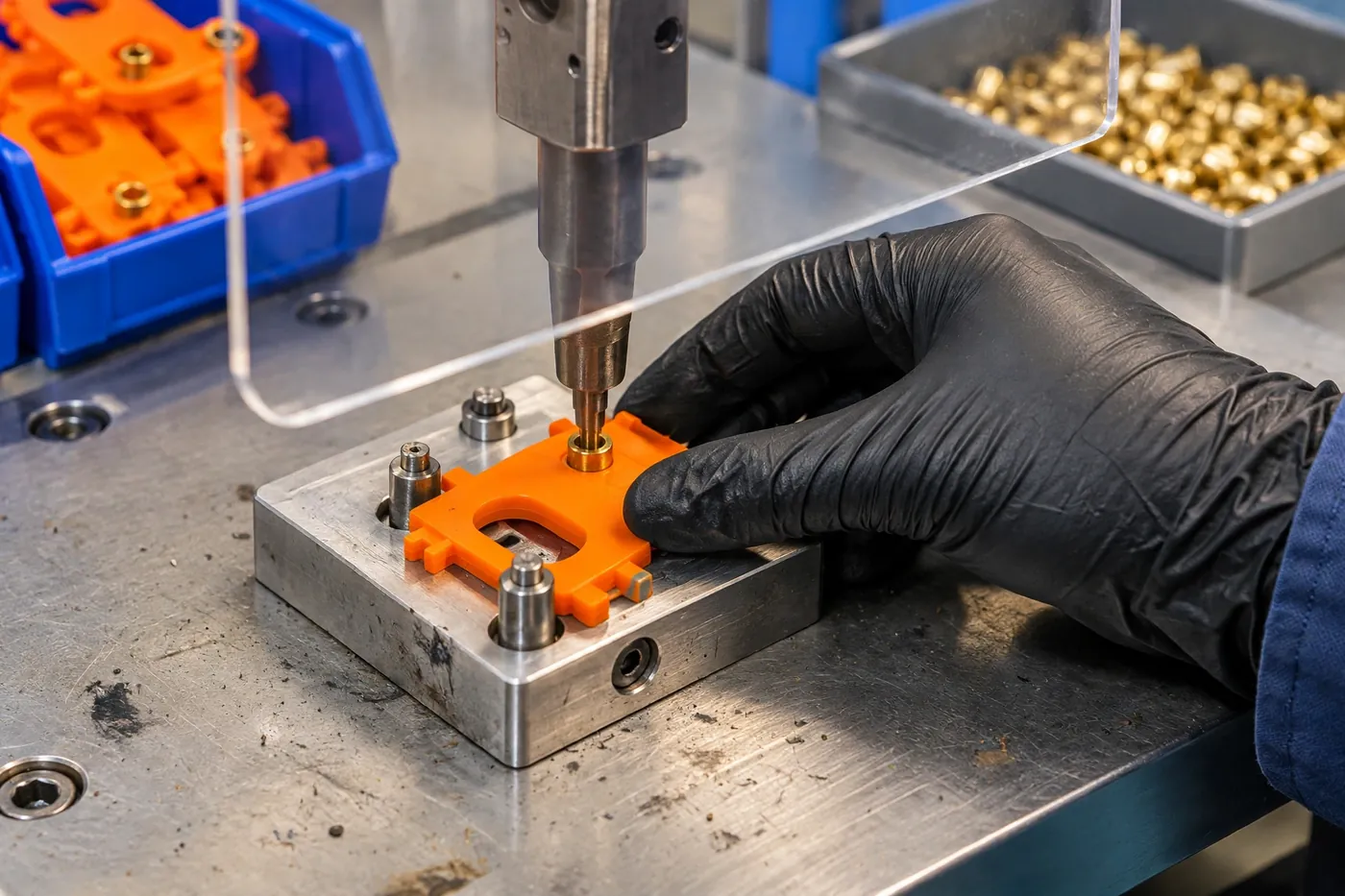
Because the joint is a mechanical lock rather than a fusion, the two materials do not need to be compatible. Plastic can be staked over metal, over composites, or over electronics hardware. No fastener, adhesive or consumable enters the assembly — which is why heat staking is used so heavily in high-voltage EV assemblies, where every metal screw removed from a joint removes an electrical clearance problem with it.
The discipline of the process is thermal. The boss must reach forming temperature at the joint interface — not merely at the machine setting — and pressure must be maintained through cooling so the head consolidates and holds its dimensions. Managed badly, the same heat that forms the joint can damage the material, which is why we treat preventing plastic degradation in heat staking as a process-control subject in its own right.
Ultrasonic welding and ultrasonic staking
Ultrasonic welding takes the opposite route. A converter turns electrical energy into mechanical vibration at 20–40 kHz, and a shaped tool — the horn, or sonotrode — delivers that vibration to the part under pressure. Friction at the joint interface melts a small, designed feature (in welding, usually a triangular ridge called an energy director) in a fraction of a second. The melt solidifies under a brief hold force, and the two plastics are fused.
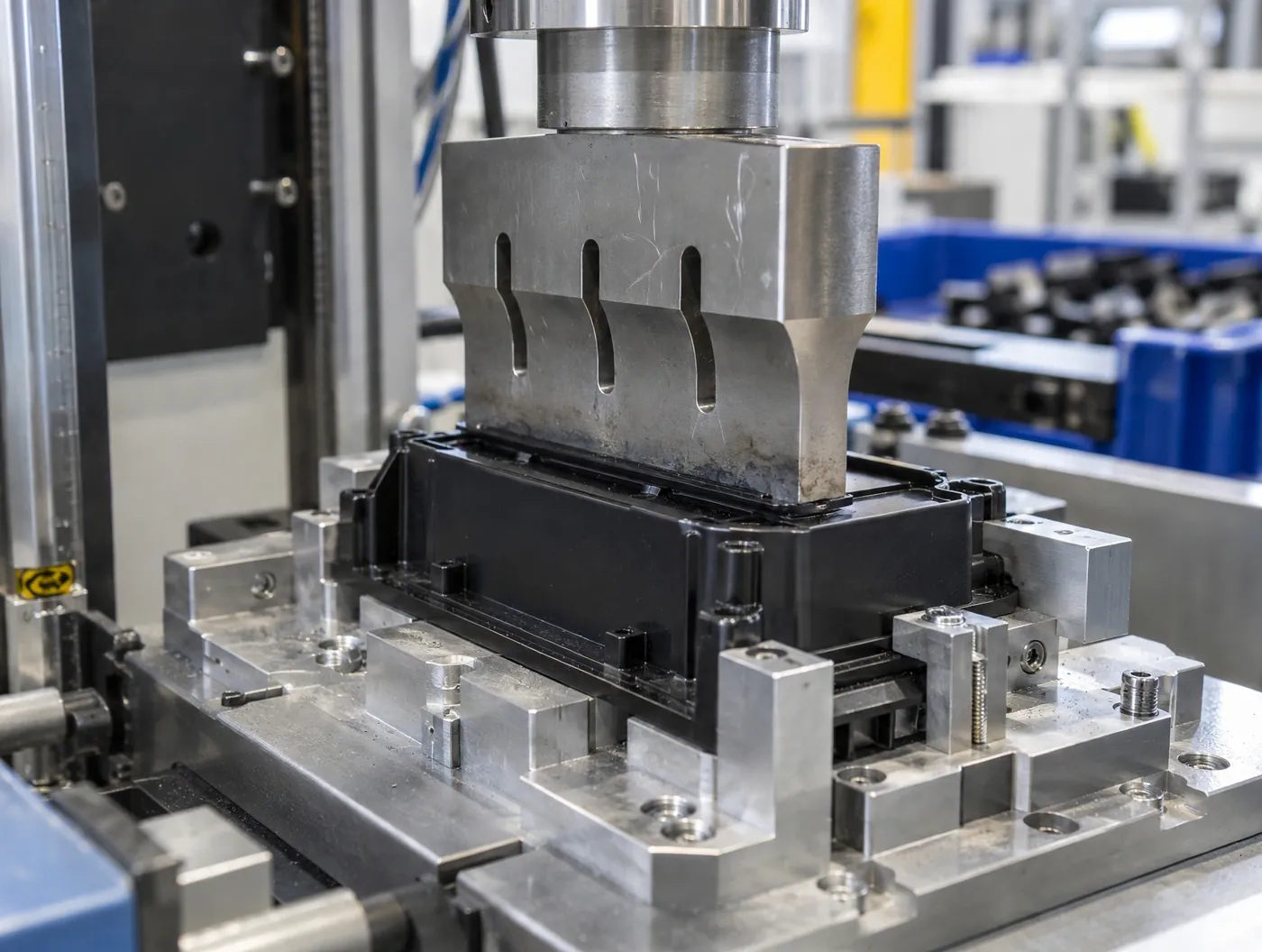
Used on a single boss rather than a weld seam, the same energy reforms the boss over the mating part; this is ultrasonic staking. The joint looks similar to a heat-staked joint, but it was made by vibration rather than conducted heat — and that difference drives almost every row of the decision table.
The defining characteristic is that the energy does not stay at the joint. Vibration travels through the component and everything attached to it. On a robust, unfilled plastic housing, that is irrelevant. On a populated circuit board or a part carrying sensors, it can be the fact that decides the process before cost or speed are even discussed, as trade coverage of PCB assemblies makes clear.
Head to Head: The Factors That Actually Decide
1. Material — the most common deciding factor
Ultrasonic energy couples best into rigid, unfilled, amorphous plastics such as ABS and polycarbonate, which transmit vibration efficiently and melt predictably. Semi-crystalline materials like nylon absorb more energy and need more from the process; glass fibre makes it harder again, because the fibres do not melt — only the resin matrix around them does.
Heat staking applies its energy by conduction, directly where it is needed, so it is far less dependent on how the material transmits vibration. Equipment manufacturers rate thermal staking for glass-filled materials up to high fill percentages, and in practice glass-filled grades such as PA66-GF30 — the workhorse of EV battery and under-bonnet components — are heat staked every day in production. If your part is glass-filled, semi-crystalline, or both, that usually settles the question in favour of heat.
2. What is being joined to what
Ultrasonic welding fuses two thermoplastics. It cannot fuse plastic to metal — there is no melt compatibility — although ultrasonic staking can capture a metal part mechanically in the same way heat staking does. Heat staking makes no distinction: any mating part that fits under the formed head can be locked, which is why it appears wherever injection moulded components meet busbars, brackets, insert hardware or boards in automotive plastic components.
3. What else is in the assembly
If the assembly carries populated electronics, solder joints, sensors, crystals or fine-pitch components, ultrasonic vibration is a genuine risk, not a theoretical one. Damage may not appear at end-of-line testing; it can appear as intermittent field failures. Heat staking’s energy stays in the boss, which is why it is the default for PCB retention and connector assemblies. If the assembly is a plain plastic housing with nothing delicate inside, this factor carries no weight — score it neutral.
4. Joint count and geometry
One joint, one horn, one very fast cycle: ultrasonics are hard to beat. Twenty joints on one carrier is a different calculation. A multi-head heat staking tool forms all twenty in a single cycle, each point independently controlled — a point the plastics trade press has made for years — while twenty ultrasonic points mean complex multi-horn tooling or twenty sequential cycles. Count the joints per part before comparing “cycle times” from a brochure; per-joint speed and per-part speed are not the same number.
5. Cycle time and automation
For a single joint, ultrasonic is faster — melt in under a second, brief hold, done. Heat staking needs heat-up, forming, and cooling under pressure, and that cooling phase cannot be shortcut without giving back joint quality. At volume, however, both processes automate well: heat staking through multi-head cells that stake a whole part at once, ultrasonics through rotary or servo-driven cells that exploit the short cycle. Judge total part cycle time in your geometry, not the process headline figure.
6. Appearance and joint requirements
An ultrasonic weld line can be nearly invisible and, properly designed, hermetic — the right choice for sealed consumer housings and medical or filtration parts. A heat-staked head is visible by design; it is a mechanical feature, and in industrial and automotive assemblies that is accepted and often preferred, because the joint can be inspected visually and its form verified. If the specification calls for a sealed, fused enclosure, that requirement alone can decide for ultrasonics.
7. Process control and validation
Both processes fail quietly when they are run badly; they just fail differently. Ultrasonic quality depends on energy, amplitude, force and fixture rigidity, and its characteristic defects are marking, flash and boss-base cracking when the post design lacks an adequate radius. Heat staking quality depends on the thermal window, the pressure profile and the cooling phase, and its characteristic defects — degradation and under-consolidation — are the subject of our detailed guide to heat staking parameters and defects. For an automotive or EV programme, the real question to ask any supplier is not which process they own, but how they validate it: monitored parameters per cycle, first-article evidence, and traceability back to the conditions under which each joint was formed.
8. Total cost — tooling, cycle and scrap combined
Neither process is “the cheap one” in the abstract. Ultrasonic welding concentrates cost in the horn and the generator: excellent economics for one fast joint repeated millions of times, weaker economics as joint count and part size grow. Heat staking spreads cost across the staking tool: a multi-point tool costs more than a single tip, but it prices twenty joints at one cycle instead of twenty. The honest comparison includes three numbers together — tooling, true per-part cycle time in your geometry, and scrap risk from the process’s characteristic defects. Assembly operations sit inside total part cost, so the joining decision should be made at DFM stage, when changing it is still free.
Designing the Joint: Boss and Weld Design Rules
The process decision and the part design are the same decision. A joint designed for one process and produced on the other is a common and expensive mistake, because the geometry is locked in when the injection mould tooling is cut.
Designing for heat staking
- Give the boss enough material volume for the head profile you need — an undersized post forms a head that looks right and holds nothing.
- Keep the boss wall and base free of sinks and voids; the stake can only be as strong as the moulded post beneath it.
- Avoid sharp internal corners at the boss base, which concentrate stress exactly where the formed material will load.
- Design the mating part’s hole and edge so the formed head captures it with clearance for thermal expansion in service.
Designing for ultrasonic welding
- Design the energy director for the material pair: its size and angle set how the melt initiates and flows.
- Keep the joint as close to the horn contact surface as the geometry allows; vibration energy falls off with distance through the part.
- Provide a generous radius at any boss base used for ultrasonic staking — post cracking at the base is the process’s signature defect.
- Fixture support must sit directly under the joint; a part that can flex absorbs the energy that should be melting the interface.
Which Process Fits Your Industry?
EV and automotive
Battery module carriers, busbar frames, end plates and under-bonnet components are dominated by glass-filled semi-crystalline materials and by assemblies that carry high-voltage hardware. That combination points to heat staking in most cases — and it is why our automotive plastic components programmes treat staking as a validated production process, not an assembly afterthought. Sealed plastic housings elsewhere in the vehicle, such as sensor and lighting enclosures in unfilled materials, are natural ultrasonic welding candidates.
Electronics and PCB assemblies
Boards carrying solder joints, crystals or sensors should not be exposed to ultrasonic vibration at the retention points. Heat staking retains PCBs, displays and connector hardware without transmitting energy into the assembly — the reason it is the standard answer for board retention in moulded housings.
Medical and consumer housings
Where the product is a sealed enclosure in ABS, PC or a blend — filtration housings, handheld devices, appliance shells — ultrasonic welding delivers the hermetic, near-invisible seam the design usually specifies. Where the same product family needs metal inserts, threaded hardware or mixed materials, staking takes over for those joints.
Industrial assemblies
Industrial components mix everything: glass-filled structural parts, metal brackets, inserts and occasional sealed covers. Most industrial assemblies use both processes on the same product, joint by joint — which is an argument for choosing a supplier on validation capability rather than on a single machine.
A Worked Example: Two Parts, Two Answers
Part A — an EV busbar carrier in PA66-GF30, with more than twenty retention points, live busbar hardware in the assembly, and a service life of thermal cycling and vibration. Every factor points the same way: glass-filled semi-crystalline material, dissimilar materials at the joint, sensitive high-voltage contents, high joint count. Answer: multi-head heat staking, with the process window validated and cooling held under pressure.
Part B — a two-piece consumer housing in unfilled ABS that must be sealed against dust and splash, with no internal components fitted before closing. Material, sealing requirement and appearance all point the other way. Answer: ultrasonic welding with a designed energy director and a rigid fixture under the weld line.
Neither answer is a preference. Both are conclusions the factors force — and reaching them costs nothing at design stage, while reversing them after tooling costs a great deal.
When to Choose Heat Staking
- The part is glass-filled (e.g. PA66-GF30) or semi-crystalline
- Plastic must capture metal, a PCB, or another dissimilar material
- The assembly contains vibration-sensitive electronics or solder joints
- The part has many staking points that should form in one cycle
- The joint is structural and must hold under thermal cycling and vibration, as in EV battery modules
- No fasteners or adhesives are permitted in the design (weight, clearance, chemistry)
When to Choose Ultrasonic Welding
- Two compatible thermoplastics must be fused into one part
- The joint must be sealed or near-invisible (consumer, medical, filtration housings)
- Cycle time per joint is the overriding pressure and joint count is low
- The parts are unfilled amorphous plastics (ABS, PC, blends)
- Nothing in the assembly can be harmed by vibration
- Small parts at very high speed, where horn access is straightforward
Five Questions to Ask Before You Decide
- What is the material, exactly — including filler? Grade and glass content decide more than any other single fact.
- What is being joined to what? Plastic-to-plastic fusion and plastic-over-metal capture are different jobs.
- What else lives in the assembly? List every component that vibration or heat could reach.
- How many joints per part, and how many parts per year? This converts brochure cycle times into real per-part economics.
- How will the joint be validated at volume? Ask for the process window, the monitored parameters, and the inspection evidence — before tooling is cut, while the boss and joint design can still be changed at no cost.
Common Mistakes We See
- Choosing on per-joint cycle time alone, then discovering the twenty-joint part is slower on ultrasonics than on a multi-head staking cell.
- Treating staking as an afterthought. Boss diameter, wall and head volume are set in the mould tool. A boss designed for ultrasonic staking is not automatically right for heat staking, and changing it after tooling costs real money.
- Ignoring material state. Hygroscopic materials like PA66 absorb moisture that changes how they respond to any thermal process; a joint programme that does not control incoming material state will chase variation it created itself.
- Judging joints by appearance. A well-formed head can still be under-consolidated inside; a clean weld line can still hide a cracked boss base. Both processes need parameter-based validation, not visual confidence.
The Haumann Position
We run both processes as part of our precision OEM assembly services, alongside resistance welding and CNC post-processing, because the right answer depends on the part in front of us — its material, its joint count, its contents and its annual volume. A supplier with only one process will recommend that process. The decision framework above is the one our engineers apply at DFM stage, before tooling commits the design.
Have a plastic assembly to join? Send us the part design — STEP or IGES file, target resin, annual volume and the joint’s job in the assembly — and our Houston engineering team will review manufacturability and recommend the joining process with the reasoning documented. Request a free DFM review or email globalsales@haumann-group.com.
Frequently Asked Questions
Can heat staking join dissimilar materials, such as plastic to metal?
Yes. Heat staking forms a mechanical lock, so the plastic boss can capture metal brackets, busbars, inserts, PCBs and other materials without needing melt compatibility between them. This is one of its principal advantages over ultrasonic welding, which fuses two thermoplastics and cannot weld plastic to metal.
Is ultrasonic welding stronger than heat staking?
Neither is universally “stronger” — they create different joints. A well-designed ultrasonic weld fuses material across the joint interface and can be extremely strong and sealed. A well-formed heat stake provides a positive mechanical lock whose strength depends on boss design, material and process control. The correct comparison is joint performance in your geometry and load case, validated by testing — not a generic ranking.
What is the difference between ultrasonic welding and ultrasonic staking?
Ultrasonic welding fuses two plastic parts together along a joint line, using vibration-generated friction heat. Ultrasonic staking uses the same vibration energy on a single plastic boss, reforming it into a head that mechanically captures a second part — which can be metal or electronics hardware. Welding creates a material bond; staking creates a mechanical lock.
Which process is cheaper: heat staking or ultrasonic welding?
It depends on joint count and volume. Ultrasonic equipment for a single joint can be economical and its cycle is very fast, but horn costs rise with joint complexity. Heat staking tooling is efficient when many points are formed in one cycle, which lowers per-part cost on multi-joint assemblies. Request a comparison on your actual part rather than relying on generic per-joint figures.
Can glass-filled nylon such as PA66-GF30 be ultrasonically welded?
It can be attempted, but glass-filled and semi-crystalline materials transmit ultrasonic energy poorly and demand more energy, with greater risk of inconsistent joints — only the resin melts, the fibre does not. Heat staking is generally the more controllable and widely used process for PA66-GF30 assemblies, particularly in EV battery components.
Which process is safer for electronics and PCBs?
Heat staking. Its energy is conductive and remains localised in the boss. Ultrasonic vibration travels through the whole assembly and can damage solder joints, sensors and other vibration-sensitive components — sometimes in ways that only appear as field failures.
How many joints can be heat staked at the same time?
As many as the tooling is built for. Multi-head heat staking equipment forms all of a part’s staking points in a single cycle, with each point independently controlled for temperature and pressure. This is why heat staking is economical on parts with many joints, such as battery module carriers, while ultrasonic systems usually process one horn position at a time.
Do heat staked joints loosen over time?
A correctly designed and validated heat staked joint does not rely on friction or thread engagement, so there is nothing to back out or loosen in the way a screw can under vibration. Its long-term performance depends on boss design, material choice, correct forming and cooling under pressure — which is why the process window, not the appearance of the head, is what must be validated.
Which process is better for high-temperature or under-bonnet automotive parts?
Heat staking is usually preferred for glass-filled, semi-crystalline engineering plastics used under the bonnet, because those materials respond poorly to ultrasonic energy, and because staked joints add no metal fasteners to the assembly. The final choice still depends on what is being joined and what else is inside the assembly.
Can both processes be automated for high-volume production?
Yes. Heat staking automates through multi-head cells that form all of a part’s joints in one cycle; ultrasonic welding automates through fast single- or multi-station cells. At volume, the deciding factors are joints per part, material, and how each process is validated cycle by cycle.